
Five Ways Macro Nutrient Tracker Apps Simplify Choices
Discover how macro nutrient tracker apps make food logging effortless with voice input, AI calculations, and personalized goals. Track smarter today.
You start tracking your macros with the best intentions, but two weeks later you're staring at a food database trying to figure out if your homemade stir-fry is closer to "chicken vegetable mix A" or "Asian chicken bowl B" while your dinner gets cold. Most people abandon macro tracking because traditional apps turn every meal into a 5-minute data entry project that requires weighing, searching, and calculating. Modern macro nutrient tracker apps like MyFoodBuddy are fixing this problem by letting you simply say what you ate and handling all the math automatically.
Table of Contents
The Evolution of Macro Tracking Tech
Most people who tried tracking their food intake in the early 2000s gave up within two weeks. The process was exhausting, requiring a notebook, a food scale, and a thick reference book listing nutritional values for thousands of foods. Every single meal meant flipping through pages, weighing portions, and doing math to calculate your daily totals. It's no wonder that only the most dedicated athletes and bodybuilders stuck with it long enough to see results.
When Apps First Arrived
The first wave of calorie tracking apps seemed like a miracle when they launched. No more notebooks or reference books needed. But anyone who used these early apps knows they came with their own headaches.
Here's what made those first-generation apps so time-consuming:
- Searching through massive databases to find the exact brand and serving size
- Creating custom entries when your food wasn't listed correctly
- Weighing and measuring every ingredient in your meals
- Manually adjusting portion sizes with confusing slider controls
- Logging each component of mixed dishes separately
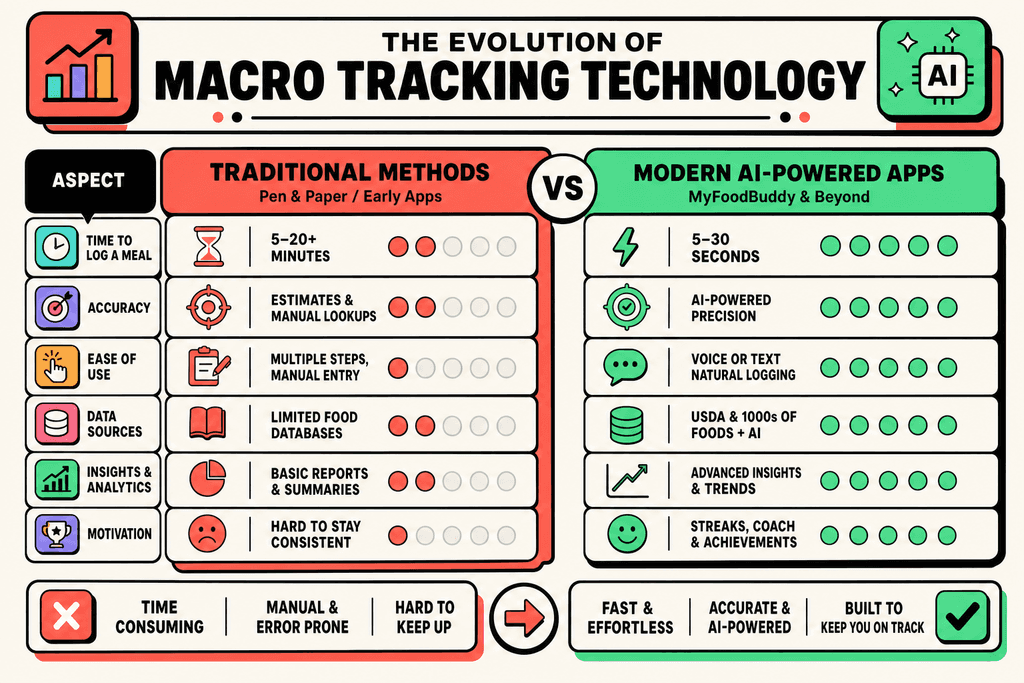
Studies show that traditional macro nutrient tracker app users spent an average of 5-10 minutes logging each meal. That adds up to over an hour per day just recording what you ate. Most people don't have that kind of time, which explains why tracking apps have such high abandonment rates.
How Modern Apps Changed Everything
The latest generation of tracking tools works completely differently. Instead of searching databases and entering numbers, you just tell the app what you ate in plain English. Apps like MyFoodBuddy use AI technology combined with USDA nutritional data to understand natural language and calculate everything automatically.
The difference in user experience is dramatic:
| Method | Time Per Meal | Steps Required | Accuracy Level |
|---|---|---|---|
| Pen and Paper | 10-15 minutes | 8-10 steps | Low to Medium |
| First-Gen Apps | 5-10 minutes | 5-7 steps | Medium |
| AI-Powered Apps | Under 30 seconds | 1-2 steps | High |
This speed difference matters more than you might think. When logging takes less than half a minute, people actually stick with it. The barrier between thinking about tracking and actually doing it basically disappears. You can log your breakfast while your coffee brews or record your lunch while walking back to your desk.
Why Accuracy Improved With Less Effort
The old assumption was that faster logging meant less accurate data. But modern macro nutrient tracker app technology proves that wrong. AI systems trained on comprehensive USDA databases can estimate nutritional values more consistently than most people manually searching through app databases.
Here's what makes modern tracking more reliable:
- Direct integration with verified nutritional databases
- AI that understands context and common portion sizes
- Automatic syncing with health data from devices like Apple Health
- Smart learning that improves accuracy based on your eating patterns
The technology handles all the complex calculations behind the scenes. You get detailed breakdowns of over 20 nutrients without spending time on data entry. This combination of speed and accuracy is what finally makes consistent tracking realistic for regular people, not just fitness professionals.
Voice and Text Input Eliminates Database Searching
Most people quit tracking their food within the first week, and the reason is simple: searching through endless food databases is exhausting. Traditional apps make you scroll through hundreds of entries just to find "chicken breast, grilled" versus "chicken breast, baked" versus "chicken breast, rotisserie." The differences are tiny, but you still have to pick one. Then you do it all over again for every single ingredient in your meal. A macro nutrient tracker app that uses natural language processing changes everything because you can just say what you ate and move on with your day.
MyFoodBuddy processes voice and text input instantly using AI and USDA data. You don't need to think about how the app wants you to phrase things. Just talk like a normal person.
- Say exactly what you ate in plain English without searching databases
- The AI understands context like "coffee with oat milk" or "toast with butter"
- No more scrolling through hundreds of similar food items
- Logging a full meal takes 10-15 seconds instead of 3-5 minutes
The time difference adds up fast. If you're logging three meals a day, that's saving you about 10 minutes daily. Over a month, you get back five hours of your life that you would have spent tapping through menus.
AI-Powered Calculations Remove the Guesswork
Manual calorie counting means doing math in your head while you're hungry, which is when your brain works the worst. You're trying to remember if that chicken breast was 4 ounces or 6 ounces, whether the olive oil you used was a tablespoon or a teaspoon, and how many grams of protein are in Greek yogurt. Most people just guess, which makes their tracking basically useless. The whole point of using a macro nutrient tracker app is to get accurate data, but traditional apps still make you do most of the work yourself.
MyFoodBuddy's AI extracts nutritional data from USDA databases automatically, so you're getting reliable numbers without lifting a finger. The system tracks over 20 nutrients including vitamins and minerals, not just the basic three macros that most people focus on.
- AI pulls data from USDA databases without manual input
- Tracks 20+ nutrients automatically versus the 3-4 most people manually track
- No need to estimate portion sizes or do mental math
- The system learns from your eating patterns to improve accuracy
- Eliminates common errors from manual calorie counting
The difference between tracking three macros and tracking 20+ nutrients is huge for your health. You might hit your protein goal but miss out on iron or vitamin D without realizing it. Apps that simplify diet tracking handle this complexity in the background so you can focus on eating well instead of becoming a nutrition calculator.
Smart Meal Organization Speeds Up Repeat Logging
Here's something nobody talks about: most people eat the same 10-15 meals on rotation. You probably have your go-to breakfast, a few lunch options you cycle through, and maybe three dinners you make regularly. Traditional apps make you log these meals from scratch every single time, which feels like punishment for having a routine. A good macro nutrient tracker app should make repeat logging almost instant, not treat it like a brand new task.
MyFoodBuddy lets you save frequently eaten meals as favorites for one-tap logging. You can organize everything by Breakfast, Lunch, Dinner, and Snack categories, which means re-logging yesterday's breakfast takes literally two seconds.
- Save your regular meals as favorites
- Organize by meal categories for quick access
- Build a personal meal library that grows with your habits
- Perfect for people who eat similar meals regularly
- Re-log entire meals with one tap
This feature alone makes consistency way easier. When tracking takes two seconds instead of two minutes, you're much more likely to actually do it every day. Fast meal logging methods turn tracking from a chore into something you barely notice.
Personalized Goals Keep You on Track Without Overthinking
Setting nutrition goals usually involves opening five different websites, using three calculators, and still not being sure if you did the math right. You need to figure out your TDEE, decide on a calorie deficit or surplus, calculate macro percentages, and then somehow remember all those numbers. Most people just pick round numbers like "2000 calories" and hope for the best. A proper macro nutrient tracker app should handle this complexity for you, not add to it.
The built-in TDEE calculator in MyFoodBuddy automatically sets macro targets based on your goals, whether that's weight loss, maintenance, or muscle gain. You can customize both macro and micro nutrient targets without touching a spreadsheet.
- Automated TDEE calculator sets targets based on your specific goals
- Customize goals for weight loss, maintenance, or muscle gain
- Set macro and micro targets without manual calculations
- Visual progress tracking shows daily goal proximity
- AI coach Fiona provides personalized insights based on your patterns
The AI coach feature is particularly useful because it spots patterns you'd miss on your own. Maybe you're consistently low on protein at lunch, or you tend to go over your carb goal on weekends. AI-powered tracking apps can identify these trends and suggest adjustments before they become problems.
Analytics and Gamification Make Consistency Effortless
The hardest part of nutrition tracking isn't the logging itself, it's doing it every single day for weeks or months. Your brain needs feedback to stay motivated, but most apps just show you a bunch of numbers that don't mean much. You need to see your progress in a way that actually registers emotionally, not just intellectually. That's where visual analytics and gamification elements come in, turning raw data into something that keeps you engaged.
MyFoodBuddy includes a color-coded calendar that shows your tracking consistency at a glance, plus weight trend charts that visualize progress over time. The app also uses streaks and achievements to reward consistent logging, and reminders help build the habit without being annoying.
- Color-coded calendar displays tracking consistency visually
- Weight trend charts show progress patterns over time
- Streaks and achievements reward consistent logging
- Smart reminders build habits without being pushy
- Comprehensive metrics across various time ranges reveal hidden patterns
Research shows that users with streak tracking are three times more likely to maintain consistent logging habits. It's not about being childish, it's about giving your brain the dopamine hit it needs to keep going. User-friendly tracking apps understand that motivation isn't just about willpower, it's about design.
When you combine all five of these features, you get a macro nutrient tracker app that actually fits into your life instead of demanding you reorganize everything around it. The voice input saves time, the AI handles calculations, the meal organization speeds up repeat logging, the automated goals remove guesswork, and the analytics keep you motivated. That's how tracking becomes sustainable instead of something you quit after two weeks.
Making Macro Tracking Actually Work for Your Life
The difference between macro tracking that works and macro tracking that gets abandoned after two weeks comes down to one thing: how much friction is involved. Traditional apps made you search through databases, weigh every ingredient, and spend five minutes logging a simple breakfast. That's why most people quit. Modern macro nutrient tracker apps solve this by letting you log meals in seconds instead of minutes, which is the only way tracking becomes sustainable long-term.
Voice input removes the need to type anything. AI calculations mean you never have to guess portion sizes or add up numbers yourself. Smart organization lets you save your regular meals so you're not starting from scratch every day. These features aren't just nice to have, they're what make the difference between tracking for a week versus tracking for a year.
MyFoodBuddy brings all of these features together at $39 per year with a 7-day free trial. You can log meals in under 10 seconds using natural language, and the app handles everything else. The goal isn't to make tracking perfect, it's to make it easy enough that you actually stick with it.
Consistency beats perfection every time when it comes to nutrition. The best macro nutrient tracker app is the one you'll actually use tomorrow, next week, and next month. If you're curious about choosing the right tracking app or want to learn more about what features matter most, there's more to explore. But the main takeaway is simple: tracking only works if it fits into your actual life.
Common Questions About Macro Nutrient Tracker Apps
Switching to a new way of tracking what you eat brings up a lot of questions. Most people wonder if these newer apps actually work better than the old method of searching through food databases and manually entering everything. The truth is that voice-based tracking has changed how accurate and fast the whole process can be, but it works differently than what you might be used to. Here are the answers to the most common questions people ask before trying a macro nutrient tracker app with AI features.
How accurate is voice-based food logging compared to manual entry?
Voice logging is just as accurate as manual entry because both methods pull from the same USDA nutritional database. The difference is that AI interprets what you say and matches it to the database automatically, while manual entry requires you to search and select items yourself. Apps like MyFoodBuddy use AI to understand natural language, so saying "two eggs and toast with butter" gets processed the same way as if you manually searched for each item.
Can these apps track micronutrients or just macros?
Modern macro nutrient tracker apps track way more than just protein, carbs, and fat. Most track over 20 different nutrients including vitamins and minerals like iron, calcium, vitamin D, and B vitamins. This gives you a complete picture of your nutrition, not just the basic macros that older apps focused on.
Do I need to weigh my food for accurate tracking?
You don't need a food scale to get started with tracking. Most people get great results using standard measurements like cups, tablespoons, or simple descriptions like "medium apple" or "palm-sized chicken breast." Weighing food can make tracking more precise, but it's not required unless you're trying to hit very specific goals or competing in something.
How long does it actually take to log a meal with voice input?
Voice logging takes about 5 to 10 seconds per meal. You just say what you ate in one sentence and the app handles the rest. Compare that to traditional apps where you might spend 2 to 5 minutes searching for each food item, selecting the right brand, and adjusting serving sizes.
What happens if the app doesn't recognize a food I ate?
When an app doesn't recognize something, you can usually add it manually or describe it differently. The AI gets better at understanding your specific foods the more you use it. You can also save custom meals and recipes so they're ready for next time without any extra work.
Is macro tracking necessary for weight loss or just helpful?
Macro tracking isn't required to lose weight, but it makes the process way more predictable. You can lose weight without tracking by eating less, but you won't know if you're getting enough protein to maintain muscle or if you're cutting calories too low. Tracking removes the guesswork and helps you make adjustments based on real data instead of how you feel.
Ready to start tracking smarter?
Download MyFoodBuddy and start tracking your calories by just saying what you ate. No more searching databases or guessing portions.
Get started