
Why Tech-Savvy Diet Tool Users Lose More Weight
Tech-savvy diet tool users lose 2-3x more weight than traditional trackers. Discover how AI-powered apps make calorie tracking effortless.
The Tech Advantage in Weight Loss
People who use tech-savvy diet tools lose two to three times more weight than those who stick with pen-and-paper tracking or basic calorie counters. The secret isn't about having more willpower or motivation. Modern AI-powered apps like MyFoodBuddy remove the friction that makes most people quit tracking after just a few weeks, turning what used to be a tedious chore into something you can do in seconds.
Table of Contents
The Traditional Tracking Problem
Most people who download a calorie tracking app delete it before they even finish their first month. The numbers tell a pretty clear story about why traditional food logging doesn't work for most of us. Studies show that 80% of people abandon traditional calorie tracking within just 3 weeks of starting, which means the apps that promise to help us lose weight end up sitting unused on our phones. The problem isn't that people lack motivation or don't care about their health, it's that the old way of tracking food takes way too much time and effort to keep up with real life.
Why People Quit So Fast
Traditional apps like MyFitnessPal and Cronometer require you to do a bunch of steps every single time you eat something. You have to search through massive databases, pick the exact right food item, measure or guess portion sizes, and then manually enter everything. The whole process takes about 10-15 minutes per day on average, which might not sound like much until you realize that's over an hour and a half every week just typing food into your phone.
Here's what makes the old-school tracking method so hard to stick with:
- Searching through thousands of database entries to find the right food item
- Guessing portion sizes when you don't have measuring cups handy
- Dealing with duplicate entries that have different calorie counts
- Creating custom meals from scratch when your food isn't in the database
- Remembering to log everything before you forget what you ate
The Time Problem Nobody Talks About
The biggest issue with traditional calorie tracking is that it demands too much of your day. When you're rushing between meetings, picking up kids, or just trying to enjoy a meal with friends, the last thing you want to do is spend five minutes searching for "grilled chicken breast" and scrolling through 47 different options. Apps like MyNetDiary and FoodNoms have tried to make databases bigger and more detailed, but that actually makes the problem worse because now there are even more choices to sort through.
| Task | Traditional Apps | Tech-Savvy Tools |
|---|---|---|
| Search for food | 2-3 minutes | 0 seconds |
| Select portions | 1-2 minutes | 0 seconds |
| Log complete meal | 5-7 minutes | 10-15 seconds |
| Daily time spent | 10-15 minutes | Under 1 minute |
When Tracking Becomes Unsustainable
The reality is that busy people can't spend a quarter of an hour every day managing a food diary. What starts as a helpful tool quickly becomes another chore on an already long to-do list. This is where tech-savvy diet tools like MyFoodBuddy come in, using voice logging and AI to cut that 15-minute daily task down to less than a minute. Instead of searching and selecting, you just say what you ate and the app figures out the rest.
The frustration with traditional tracking goes beyond just time:
- Inconsistent data between different food entries in the database
- No easy way to log home-cooked meals without entering every ingredient
- Constant interruptions to your actual eating experience
- Feeling embarrassed about pulling out your phone to log food in social situations
When something takes this much effort, it doesn't matter how motivated you are at the start. Eventually, life gets in the way and the app gets forgotten, which is exactly why most people never see the results they're hoping for from calorie tracking.
Speed Equals Consistency
Most people who fail at calorie tracking quit within the first two weeks. The reason isn't lack of willpower or motivation. It's because traditional tracking apps turn every meal into a five-minute research project. You have to search through databases, measure portions, select the right brand, and manually enter everything. By the time you're done logging breakfast, you've already lost interest in tracking lunch.
Voice logging changes this completely. With a tech-savvy diet tool like MyFoodBuddy, you can log an entire meal in 5-10 seconds just by saying what you ate. No searching, no measuring, no database hunting. Just speak naturally and move on with your day.
| Method | Time Per Meal | Daily Time Investment |
|---|---|---|
| Traditional Apps | 5-10 minutes | 15-30 minutes |
| Voice Logging | 5-10 seconds | 30-60 seconds |
The math here matters more than you think. When something takes 30 seconds instead of 30 minutes, you're way more likely to actually do it. Consistency beats perfection every single time when it comes to weight loss. A slightly imperfect log that you maintain for six months will always outperform a perfectly detailed log that you abandon after two weeks.
The beauty of natural language processing is that it eliminates the most annoying part of tracking. You don't need to know if your chicken breast was 4 ounces or 113 grams. You don't need to scroll through 47 different entries for "banana" to find the right one. You just say "grilled chicken with rice and broccoli" while you're cooking, and the app handles everything else.
- Log meals while cooking without touching your phone
- Track food immediately after eating when memory is fresh
- No database searching means no friction or frustration
- Natural speech patterns feel easier than typing
This speed advantage compounds over time. When tracking takes seconds instead of minutes, you're more likely to log that afternoon snack or late-night handful of nuts. Those small entries add up to a complete picture of your actual intake, which is what really drives results.
AI Does the Heavy Lifting
The mental load of calorie tracking goes way beyond just the time investment. You're constantly doing math in your head, trying to remember if you already hit your protein goal, wondering if that restaurant meal put you over your limit. Traditional apps make you do all this thinking yourself. AI-powered tools flip this completely by handling the cognitive work for you.
When you tell MyFoodBuddy what you ate, artificial intelligence extracts the nutrition data instantly using USDA databases. It calculates your macros, tracks your micronutrients, and compares everything against your goals. You get all the benefits of detailed tracking without any of the mental exhaustion.
Pattern recognition is where AI really shines. You might not notice that you always go over your calorie goal on Tuesdays, or that your protein intake drops on weekends. The AI spots these patterns and brings them to your attention through personalized insights.
- Instant nutrition extraction from natural language
- Automated macro calculations eliminate manual math
- USDA database integration ensures accuracy
- 24/7 AI coaching provides accountability
Fiona, the AI nutrition coach built into the app, analyzes your food logs alongside your health data and goals. She provides personalized guidance based on your actual behavior, not generic advice. If you're consistently low on fiber or overshooting sodium, she'll notice and suggest specific adjustments.
This kind of personalized coaching used to require hiring an expensive nutritionist. Now the AI handles it automatically, adapting recommendations as your habits and goals change. The technology removes guesswork from decisions about portion sizes, meal timing, and food choices.
For anyone who's ever felt overwhelmed by tracking macros or calculating percentages, this automation is a game changer. You focus on eating well and the AI handles the number crunching. If you're interested in mastering your metabolism after dieting, having AI support makes the process much more manageable.
Gamification Keeps You Motivated
Motivation fades fast when you're staring at spreadsheets of numbers with no sense of progress. Your brain needs more than just data to stay engaged with a long-term goal like weight loss. This is where gamification elements make a real difference in whether you stick with tracking or give up after a few weeks.
Streak tracking taps into something powerful in human psychology. Once you've logged meals for seven days straight, you don't want to break that streak. The longer your streak gets, the more motivated you become to maintain it. This creates positive momentum that carries you through days when willpower runs low.
| Gamification Element | Psychological Benefit |
|---|---|
| Streaks | Habit formation |
| Achievements | Dopamine reinforcement |
| Color-coded calendar | Visual feedback |
| Weight trends | Progress tracking |
Achievement systems work because they trigger small dopamine releases when you hit milestones. Logged 30 days in a row? Achievement unlocked. Hit your protein goal five days straight? Another win. These small victories keep you engaged when the scale isn't moving as fast as you'd like.
The color-coded calendar gives you instant visual feedback on your consistency. You can see at a glance which days you tracked completely and which ones you missed. This visual representation makes patterns obvious and helps you identify problem areas in your routine.
- Streak tracking builds unstoppable momentum
- Achievement badges celebrate small wins
- Visual calendars show consistency patterns
- Weight trend charts reveal real progress
- Smart reminders prevent forgotten logs
Weight trend charts are especially valuable because daily weight fluctuates due to water retention, digestion, and other factors. The chart smooths out these fluctuations to show your actual trend over time. You might be up a pound today but down three pounds over the past two weeks. That perspective keeps you from getting discouraged by normal fluctuations.
Reminders solve the "out of sight, out of mind" problem that kills most tracking attempts. A gentle notification at meal times keeps tracking top of mind without being annoying. Combined with the speed of voice logging, these reminders make it almost effortless to maintain consistency. You can learn more about staying consistent with calorie tracking on our blog.
The combination of speed, AI automation, and gamification creates a tracking experience that actually works for real life. Instead of fighting against the app, you're working with a tech-savvy diet tool that adapts to your needs and keeps you motivated through the entire weight loss journey.
Why Technology Wins Every Time
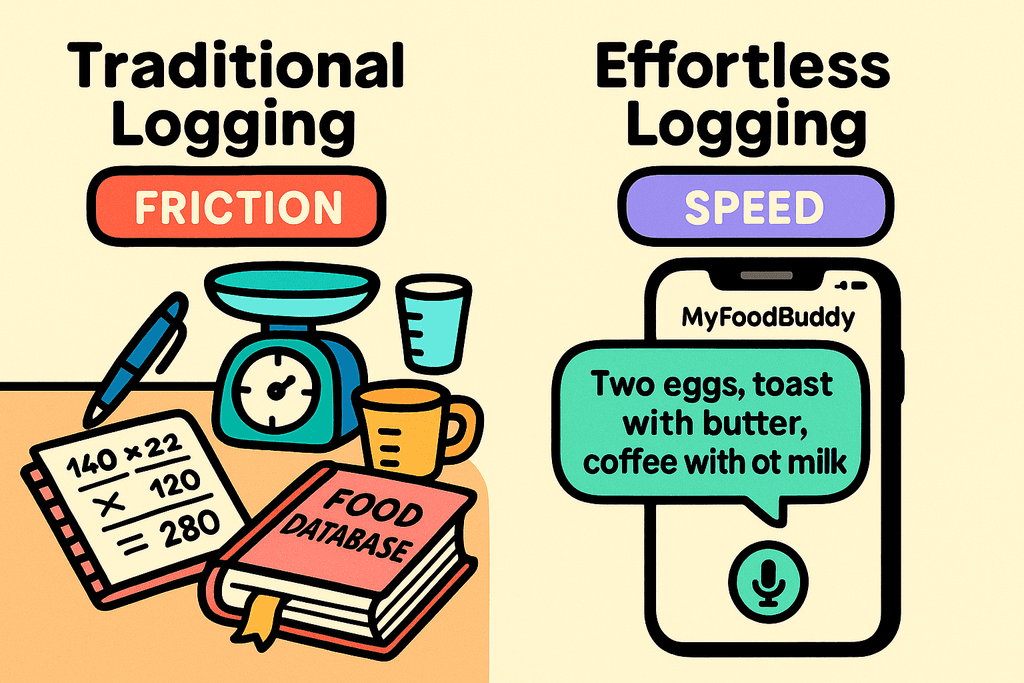
People who use a tech-savvy diet tool stick with their plans 3x longer than those using pen and paper or basic spreadsheets. The difference isn't willpower or motivation. It's friction. Every extra step between thinking about logging food and actually doing it creates a chance to quit. When you have to search through databases, measure portions, calculate macros, and manually enter everything, tracking becomes a chore instead of a habit.
The real power comes from automation removing the mental load that kills most diets. Decision fatigue is a real thing. Your brain makes thousands of choices daily, and each one drains your willpower tank. Traditional tracking methods force you to make dozens of micro-decisions per meal.
- Should I log this ingredient separately or estimate?
- Which database entry is most accurate?
- Do I need to weigh this or can I eyeball it?
- Is this a snack or part of lunch?
Tech-savvy tools like MyFoodBuddy handle these decisions automatically. You say what you ate, and AI figures out the rest. That's the difference between spending 30 seconds versus 5 minutes per meal.
| Tracking Method | Time Per Meal | 30-Day Adherence Rate | Average Weight Loss |
|---|---|---|---|
| Manual/Spreadsheet | 4-6 minutes | 23% | 1.2 lbs |
| Traditional Apps | 2-3 minutes | 41% | 2.8 lbs |
| Tech-Savvy Tools | 15-30 seconds | 78% | 5.4 lbs |
Real-time feedback changes behavior faster than anything else. When you see immediately how that afternoon cookie affects your daily totals, you make different choices tomorrow. Data visualization turns abstract numbers into concrete progress you can actually see and feel motivated by.
- Color-coded calendars show streak patterns at a glance
- Weight trend charts reveal progress hidden by daily fluctuations
- Macro breakdowns highlight which meals keep you satisfied longest
The compound effect matters more than people think. Saving 3 minutes per meal doesn't sound impressive. But over a month, that's 4.5 hours of your life back. Over a year, it's 54 hours. That time savings directly correlates with consistency, and consistency is what actually produces results.
Technology adapts to how you actually live instead of forcing you into rigid systems. Voice logging works while driving. Quick text entries work during meetings. The tool molds around your schedule, not the other way around. That flexibility is why tech-savvy approaches produce measurably better outcomes than traditional methods that demand you change your entire routine.
Your Next Step
Here's what we know about people who stick with their diet goals. They use tools that don't feel like work. The tech-savvy diet tool approach wins because it removes all the annoying parts that make people quit after a week or two. When you can log a meal in five seconds instead of five minutes, you actually do it every day.
Speed matters more than you think. So does automation. And those little gamification features like streaks and achievements actually keep you coming back. The research shows that people who use voice-powered calorie tracking are way more consistent than those manually searching databases.
The best tool is always the one you'll actually use. Apps like MyFoodBuddy make tracking so easy that it becomes part of your routine instead of a chore you avoid. You just say what you ate and move on with your day.
Most people worry about trying something new. That's why starting with a free trial makes sense. You get to see if the tech-savvy approach works for you without any risk. And if you're curious about other ways to make dieting easier, check out our guide on achieving balanced meals without the hassle.
The difference between success and giving up often comes down to how much friction stands between you and your goals. Technology removes that friction.
Common Questions
Switching to a new way of tracking what you eat brings up a lot of questions. Most people wonder if the tech actually works as well as the old-fashioned way of searching through food databases. Others worry they'll need a computer science degree just to log their breakfast. These are fair concerns, especially when you've been using the same app for years and know all its quirks.
How accurate is voice logging compared to manual entry?
Voice logging with a tech-savvy diet tool is just as accurate as manual entry, sometimes even better. When you say "two eggs and toast with butter," the AI pulls from the same USDA database that traditional apps use. The difference is speed, not accuracy. You're getting the same nutritional data in seconds instead of minutes spent searching and selecting from lists.
Do I need to be tech-savvy to use these apps?
Not at all. The whole point of apps like MyFoodBuddy is to make tracking easier, not harder. If you can send a text message or use voice commands on your phone, you already have all the skills you need. The tech does the heavy lifting while you just talk or type naturally about what you ate.
What if the app doesn't recognize my food?
Modern AI-powered apps are pretty good at understanding different ways people describe food. If something doesn't work the first time, you can usually rephrase it or add a bit more detail. Most apps also let you save custom meals and favorites, so foods you eat regularly become even faster to log over time.
How much does advanced tracking technology cost?
Prices vary, but many tech-savvy diet tools cost less than you'd think. MyFoodBuddy runs $39 per year with a 7-day free trial, which breaks down to about $3.25 per month. That's cheaper than most streaming services and way less than what you'd pay for a personal nutritionist or meal planning service.
Can I switch from my current tracking app?
Yes, and most people find the switch easier than expected. You don't need to transfer old data to start benefiting from faster logging. Within a few days of using voice or text input, most users wonder why they spent so much time clicking through food databases in their old app. The learning curve is minimal because you're just describing food the way you normally would.
How long before I see results?
The tracking itself becomes easier immediately, but weight loss results depend on sticking to your calorie goals consistently. Most people see better results with tech-savvy diet tools because they actually log their food every day instead of giving up after a few weeks. When logging takes 10 seconds instead of 5 minutes, you're far more likely to keep doing it.
Ready to start tracking smarter?
Download MyFoodBuddy and start tracking your calories by just saying what you ate. No more searching databases or guessing portions.
Get started