
Subway Calorie Counter Tool for Sandwiches
Build your Subway order with our free calorie calculator. Pick bread, protein, and toppings to see exact calories and macros instantly.
Two people can order what looks like the same Subway footlong and end up with totals nearly 900 calories apart, all because of bread, cheese, and a few extra sauce pumps. If you're trying to lose weight, that kind of swing can wreck a whole day of careful eating without you even knowing it. That's exactly why a real subway calorie counter matters more than guessing, and why we built a calculator that shows your exact totals before you order.
Table of Contents
Why Subway Calories Are Harder to Track Than You Think
Subway once said their sandwiches could be made about 37 million different ways once you count breads, cheeses, veggies, and sauces. That number sounds made up, but it's not far off. This is the exact reason a subway calorie counter matters way more than people think. Most fast food spots have a set menu with a handful of items, so figuring out calories is simple math. Subway flips that whole idea by letting you build your own sandwich from scratch every single time. That freedom is great for your taste buds but terrible for anyone trying to keep track of what they're eating.
Think about it this way. A regular burger from a fixed menu chain has one calorie count listed and that's it. But at Subway, your 6-inch turkey sub can turn into a totally different food depending on what you pick.
- Type of bread, from flatbread to Italian herb and cheese
- Cheese choice and how much they pile on
- Sauce type, since some have double the calories of others
- Extra toppings like bacon or avocado
- Footlong versus 6-inch portion size
This is where things get tricky fast. A single swap like ranch instead of mustard can add over 150 calories without you even noticing. Add extra cheese or a creamy sauce and you're looking at a sandwich that costs way more calories than the "healthy" one you thought you ordered.
Here's a look at how customization changes things compared to typical fast food ordering.
| Order Type | Calorie Variation |
|---|---|
| Fixed menu fast food item | Same every time |
| Subway 6-inch sub, basic | 250 to 400 calories |
| Subway 6-inch sub, loaded | 500 to 700+ calories |
| Footlong with extras | 800 to 1200+ calories |
Studies on customized fast food orders show people underestimate their calorie intake by 200 to 400 calories on average, and Subway sandwiches fit right into that pattern because of how many choices are involved. That gap adds up fast if you're eating there a few times a week. This is exactly why a subway calorie calculator that adjusts for your specific build, not just a generic menu average, makes such a big difference for anyone actually trying to hit their goals.
Subway Sandwich Calculator Build Your Order Below
A footlong Italian BMT can swing anywhere from 480 calories to over 1,000 depending on what you pile on. That's a huge gap, and honestly, most people have no idea where their order lands until it's too late. This calculator fixes that by letting you build your sandwich step by step and watch the numbers change in real time. No guessing, no math, just clicking through the same choices you'd make standing in line.
Here's how it works. You start with the basics and add layers, just like at the counter.
- Bread type: pick from wheat, white, flatbread, or whatever's on the list
- Size: 6-inch or footlong changes everything downstream
- Protein: turkey, steak, tuna, meatball, and more
- Cheese: add it or skip it
- Veggies: load up since these barely add calories
- Sauces: this is usually where the calories hide
- Sides: chips, cookies, drinks if you want them counted too
As you tap through each option, the calorie, protein, carb, and fat totals update instantly at the top. You don't hit a submit button or wait for a page reload. Once you've got a combo you eat often, you can save it so you're not rebuilding the same turkey sub every single day.
Quick step-by-step to try it yourself:
- Pick your bread and size first
- Add your protein and cheese
- Stack on veggies (free calorie-wise, mostly)
- Choose sauce carefully, this is the tricky part
- Add sides if needed and check your final total
How the Calculator Gets Its Nutrition Numbers
The numbers you see aren't guesses. They come straight from Subway's own published ingredient data, so a slice of provolone always adds the same calories no matter who's building the sandwich. Every topping, from banana peppers to chipotle sauce, has its own fixed value that gets added to your running total. This is the same idea behind how nutrition tracking should work in general, whether it's a sandwich shop or a home-cooked meal.
| Item | Calories |
|---|---|
| Wheat bread (6-inch) | 200 |
| Turkey breast | 50 |
| Steak | 180 |
| Mayonnaise (1 packet) | 90 |
| Mustard | 5 |
This kind of item-by-item accuracy is exactly what powers apps like MyFoodBuddy, except there you don't have to click through a build menu at all. You just say what you ate, and AI pulls the nutrition data instantly using the same kind of official sourcing. It's a small difference on paper but it saves a lot of time when you're tracking three meals a day, every day.
Tips to Build a Lower-Calorie Subway Order
If weight loss is the goal, a few small swaps in the calculator can shave off hundreds of calories without making your sandwich taste like cardboard. The biggest lever is portion size, but sauce choice is a close second. Most people don't realize how much a single squeeze of mayo-based sauce adds up over a week of lunches. Here's a quick comparison of choices that seem similar but aren't.
- Bread size: 6-inch keeps portions in check versus footlong doubling everything
- Sauce: mustard or vinegar instead of mayo or ranch, saves 100+ calories easily
- Toppings: extra veggies instead of double cheese or double meat
- Sides: baked chips over regular, or just skip the side altogether
Higher-calorie pick: footlong, double cheese, ranch, regular chips. Lower-calorie swap: 6-inch, single cheese, mustard, no side or baked chips.
None of these swaps mean eating less food. You're just being smarter about where the calories go, which is the whole point of using a calculator like this before you order instead of after.
Popular Subway Orders and Their Calorie Totals
Seeing real examples helps more than staring at a list of ingredient values. Below are three common builds people run through the calculator, showing how much the total shifts based on size and toppings alone. The gap between the lowest and highest is bigger than most people expect.
| Order | Calories | Protein |
|---|---|---|
| Turkey breast 6-inch, wheat, veggies | ~280 | 18g |
| Footlong steak and cheese, extra sauce | ~950 | 48g |
| Veggie delite 6-inch | ~230 | 8g |
That's a 670-calorie difference between the lightest and heaviest order, just from protein and sauce choices. This is why building it out first, rather than eyeballing it after you've already eaten, actually matters if you're trying to hit a daily target.
Wrapping It Up
Once you get used to checking totals before you order, it's hard to go back to guessing. The same logic applies to eating out anywhere, not just Subway, which is why tools that handle this automatically are worth looking into. If you want to go deeper on building better tracking habits with an app that fits your routine, or you're curious how voice input speeds up logging fast food orders, those are good next reads. And if sandwich shops are just one part of your week, check out how people handle finding the lowest calorie fast food meals without much effort.
At the end of the day, a calculator like this works best as a snapshot, not a daily habit. For actual day-to-day tracking, something that logs meals the second you eat them, like MyFoodBuddy, tends to stick better long term since there's no menu to click through each time.
What This Means for Your Weight Loss Goals
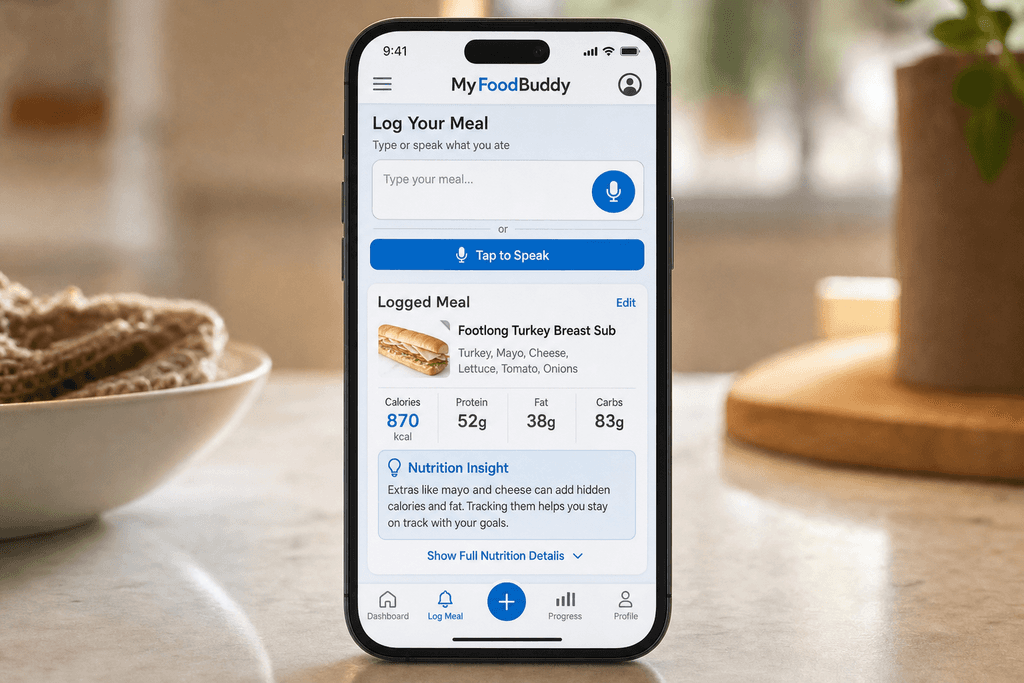
A footlong turkey breast sub sounds like a smart pick until you add mayo, extra cheese, and a cookie on the side, and suddenly you've eaten half your daily calorie budget in one sitting. This is the trap a lot of people fall into when they're trying to lose weight. They pick the "healthy sounding" option without checking what's actually in it. A subway calorie counter matters here because it takes the guessing out of the equation, showing you the real numbers before the sandwich is even made.
Toppings are sneaky. They don't look like much on their own, but they stack up fast.
- Extra mayo adds about 90 calories per swipe
- Cheese adds 40 to 80 calories depending on type
- Sauces like chipotle southwest can run 100+ calories alone
- A regular soda adds 150 to 200 calories you might forget about
Add those up on a footlong and you could be looking at 300 to 400 extra calories you didn't plan for. That's the difference between staying in a deficit and breaking even for the day.
Here's the thing though, once you know your usual order's calorie count, you shouldn't have to redo that math every single time you eat it. That's where saved meals come in handy. Instead of recalculating your go-to sandwich from scratch each visit, you log it once and reuse it with one tap. This is a small feature but it changes how consistent people actually stay with tracking.
Compared to apps like myfitnesspal.com or cronometer.com, where searching and building a custom sandwich entry can take several minutes, having a subway calorie calculator paired with a quick-logging system just makes daily tracking less of a chore. MyFoodBuddy's voice and text logging works well here too, since you can just say what you ordered and skip the manual search entirely.
Wrap-up Build Smarter Subway Orders Every Time
Here's the thing about a subway calorie counter, it turns a guessing game into real numbers you can actually use. No more standing at the counter wondering if that footlong is going to wreck your whole day. You punch in your bread, your protein, your sauce, and boom, you know exactly what you're working with.
And those small swaps matter more than people think. Switching from a footlong to a 6-inch, skipping the mayo, or picking a lighter bread can shave off a good chunk of calories without making your sandwich taste like cardboard. Once you start seeing the calories subway sandwiches actually carry, you start noticing patterns you never caught before.
But here's the part that really saves you time. Once you figure out your go-to order, like a turkey sub on wheat with light mayo, you shouldn't have to recalculate it every single time you eat there. That's where MyFoodBuddy comes in. You save your favorite order once, and then it's a one-tap log every time after that. No retyping, no rethinking, just fast and accurate tracking that fits into your day instead of slowing it down.
If you're trying to build better habits around eating out, it helps to look at the bigger picture too. Check out how voice tracking works for other fast food spots, or see what happens when you compare how accurate today's calorie counters really are. Either way, knowing your numbers is the first step, and making it effortless to log them daily is what actually keeps people on track long term.
Subway Calorie Calculator FAQs
Got more questions rattling around your head about counting calories at Subway? That's normal. Here are the ones people ask the most, answered plain and simple so you can get back to building your sandwich without overthinking it.
How accurate is the calculator compared to Subway's official nutrition info
A good subway calorie counter pulls numbers straight from Subway's published nutrition data, so it should match pretty closely. Small differences can happen if a store uses slightly different portion sizes, but for the most part, the calories subway calculator gives you will be within a few calories of what's official.
What's the lowest calorie sandwich you can build
Turkey breast or veggie subs on a 6-inch with no cheese and light sauce usually come in lowest, often under 350 calories. Stack on extra veggies instead of meat or cheese if you want to fill up without piling on calories.
- Skip the cheese to save around 50-80 calories
- Choose a lighter bread like 9-grain wheat
- Load up on veggies since they're basically free calorie-wise
Does the calculator account for footlong vs 6-inch automatically
Yes, any decent subway calorie counter should let you pick your bread size first, then adjust everything else based on that. Footlongs basically double the bread, meat, and cheese calories, so this step matters a lot.
Can I save my custom sandwich for next time
Some calculators let you save a build, but most don't remember it once you close the tab. This is one spot where MyFoodBuddy comes in handy, since you can save your go-to Subway order as a favorite and log it again in one tap instead of rebuilding it from scratch every time.
Do sauces really make that big of a calorie difference
Sauces can quietly add more calories than people expect. A few pumps of mayo or ranch can tack on 100-200 calories without you even noticing, so it's worth checking before you assume your sandwich is "healthy." Swapping to mustard, vinegar, or a light drizzle of oil can cut that number way down.
Is a salad always lower calorie than a sandwich
Not always. Once you add cheese, extra dressing, and toppings, a Subway salad can end up close to the calories of a 6-inch sub. The bread isn't always the biggest problem, it's usually what's piled on top.
Ready to start tracking smarter?
Download MyFoodBuddy and start tracking your calories by just saying what you ate. No more searching databases or guessing portions.
Get started