
MyFitnessPal Calorie Counter Review and Better Alternatives
Honest MyFitnessPal calorie counter review with pros, cons, pricing, and a faster alternative for tracking calories in 2024.
Almost half of people who start using a calorie counting app quit within the first month, usually because typing in every meal starts to feel like a second job. MyFitnessPal built its name as one of the most downloaded calorie counters out there, but that same manual search-and-log system is often why people give up on it. This review breaks down what still works with MyFitnessPal, where it falls flat, and why tools like MyFoodBuddy are worth a look if logging food has never stuck for you before.
Table of Contents
What MyFitnessPal Actually Offers
MyFitnessPal has been around since 2005, which makes it kind of like the granddaddy of calorie counting apps. Millions of people have used it over the years to log their meals, and it's probably the first app that pops up when you search for calories counter myfitnesspal on your phone's app store. But being the oldest doesn't always mean being the best fit for how people eat and live today. Before we get into the good, the bad, and the annoying parts of this app, let's look at exactly what you get when you download it.
The app runs on a huge food database, which is honestly one of its strongest points. Users can scan barcodes on packaged foods to pull up nutrition info instantly, and there's a search bar where you type in what you ate and pick from a list of matches.
- Barcode scanner for packaged foods
- Massive crowd sourced food database
- Manual search and log as the main way to add meals
- Free version with ads, paid version without
Here's a quick specs table so you can see the basics before we dig deeper into how it actually feels to use day to day.
| Feature | Free Version | Premium Version |
|---|---|---|
| Food Database | Yes | Yes |
| Barcode Scanner | Yes | Yes |
| Ads | Yes | No |
| Macro Goals | Basic | Advanced |
| Meal Logging Method | Manual search | Manual search |
| Platforms | iOS, Android, Web | iOS, Android, Web |
| Price | Free | Around $80/year |
Notice something missing from that table. There's no voice logging, no AI reading your text and figuring out calories for you. The default workflow is manual, meaning you type, search, scroll, and tap your way through every single meal. For some people that's fine. For others, especially folks juggling busy schedules, that manual grind is exactly why they stop using the app after a few weeks. Apps like foodbuddy.my take a different approach here, letting you just say what you ate out loud instead of digging through a database every time.
MyFitnessPal Pros and Cons for Weight Loss
MyFitnessPal has been around forever, and there's a reason so many people still use it. Its food database has over 14 million entries, built by users over more than a decade. That sounds great on paper, but it's actually a mixed bag once you start using it daily for weight loss. The database is huge, sure, but a lot of those entries are added by random users, which means calorie counts can be way off. You might log "chicken salad" and get three different results depending on who submitted the entry.
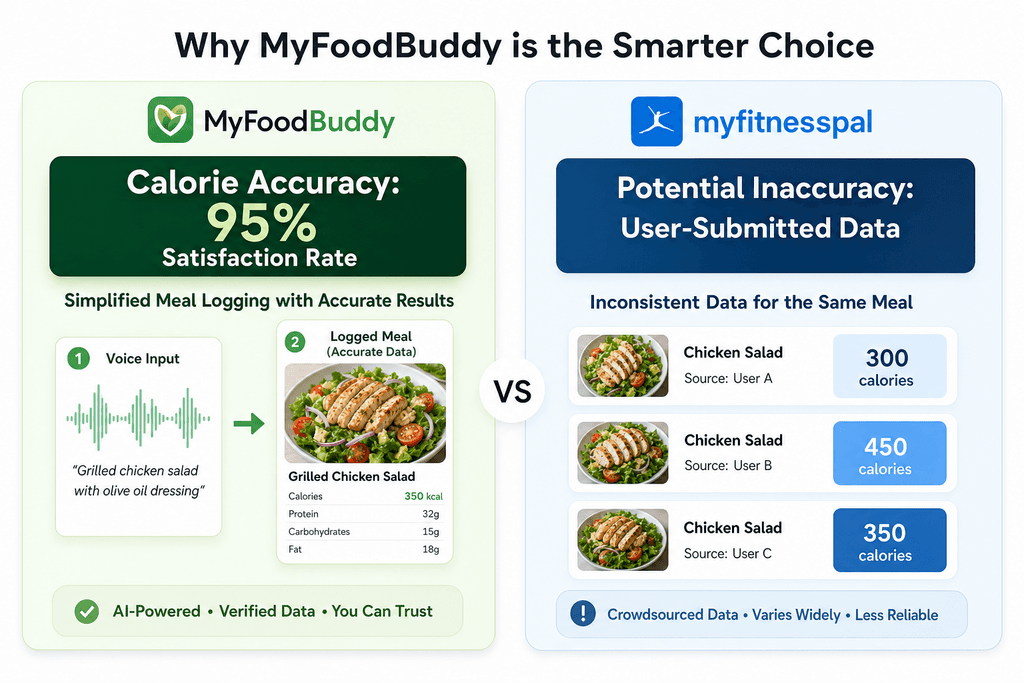
Here's a quick breakdown of what people actually experience:
- Massive food database means you'll probably find what you ate, but accuracy is hit or miss since anyone can submit entries.
- Manual entry takes real time, and after a few weeks of typing every snack and meal, a lot of people just quit.
- Ads and paywalled features on the free version get annoying fast, especially when you're trying to focus on your goals.
- Barcode scanner and community support are genuinely useful and work well for packaged foods.
So it's not all bad. If you eat mostly packaged food and don't mind typing things in, it can work fine. But for people who cook a lot or eat out often, the cracks start to show pretty quick.
Where MyFitnessPal Falls Short
The biggest complaint about MyFitnessPal isn't really about features, it's about the daily grind of using it. Since the database is crowd-sourced, wrong calorie counts pop up more often than you'd think. Someone logs a "medium banana" as 200 calories instead of 105, and now your whole day's numbers are off without you even knowing. This kind of small error adds up over weeks, especially for people watching their calories closely for weight loss.
Then there's the time factor. Typing out every single meal, searching through options, picking the right serving size, it all takes longer than people expect.
On average, manually logging meals eats up around 10 to 15 minutes a day, which sounds small until you multiply it by 365 days a year.
A few other things people run into:
- No AI coaching, just plain charts and numbers with no explanation of what they mean
- Premium pricing has crept up over the years, and features that used to be free got moved behind the paywall
- Searching for homemade or restaurant meals is often a guessing game
If you've felt this fatigue with logging, you're definitely not alone. It's actually one of the top reasons people abandon calorie tracking apps altogether within the first month.
MyFitnessPal vs MyFoodBuddy Side by Side
So what does a better logging experience actually look like? Instead of typing "grilled chicken breast 6oz" into a search bar and scrolling through ten wrong results, you just say what you ate out loud, or type it in plain words. That's the core difference between MyFitnessPal's manual search system and an AI-based approach like MyFoodBuddy. One requires you to be the calculator. The other just listens and figures out the nutrition info for you using AI and USDA data.
Here's how the two stack up:
| Feature | MyFitnessPal | MyFoodBuddy |
|---|---|---|
| Logging method | Manual search | Voice or text |
| Coaching | Static charts | AI coach Fiona |
| Barcode scan | Yes | Yes |
| Health sync | Limited | Apple Health |
| Time per meal | Minutes | Seconds |
| Yearly price | Varies | $39/year |
The AI coach part is worth mentioning too. Fiona looks at your food logs alongside sleep and activity data, so you're not just staring at numbers wondering what they mean. It's less like using a spreadsheet and more like having someone actually pay attention to your patterns.
Speed is really the main thing though. Logging a meal in seconds instead of minutes doesn't sound like much, but over months of tracking, it's the difference between sticking with it and giving up halfway through.
Figuring Out What Works for You
At the end of the day, the best calorie counter is the one you'll actually keep using. If MyFitnessPal's manual process has worn you down, you're not the only one looking around for something easier. There's a full breakdown of other options worth checking out in this list of better alternatives to MyFitnessPal for AI meal tracking, plus a closer look at what makes a calorie app actually user-friendly instead of just feature-packed.
If accuracy and speed matter more to you than sticking with something familiar, it might be worth reading up on how accurate modern calorie counters really are before picking your next app.
Who Should Actually Use MyFitnessPal
Studies on habit apps show that most people who download a diet tracker stop using it within two weeks. That number matters a lot when you're picking between calories counter myfitnesspal style manual entry and something faster. MyFitnessPal isn't a bad app, it's just built for a specific kind of person. If typing out every ingredient and weighing your chicken breast sounds relaxing to you, this section is worth reading closely. If it sounds like a chore you'll quit by Friday, keep reading too, because the answer might change your whole approach to tracking.
There's a small group of dieters who genuinely enjoy the manual process. They like control, they like precision, and they don't mind the extra minutes per meal.
- People who track macros for bodybuilding competitions
- Folks who enjoy data entry as part of their routine
- Users who already have every recipe saved and ready to go
- Anyone who's used the app for years and has a system down
But that's a small slice of the diet-tracking world. Most people fall into the second group, the ones who start strong and disappear within days.
This is where the whole industry has a consistency problem, not an accuracy problem. A slightly imperfect log you actually keep beats a perfect one you abandon by day 10.
- Busy parents who don't have five minutes per meal
- Shift workers eating on irregular schedules
- People who've quit tracking apps before out of frustration
- Anyone who wants results without turning it into homework
This is the gap AI-based tools are built to close. Instead of searching databases and weighing food, apps like foodbuddy.my let you just say what you ate. It's not about being fancier than MyFitnessPal, it's about removing the friction that makes people quit in the first place.
Wrap-up Choosing the Right Calorie Counter
MyFitnessPal has been around forever and it works. That huge food database is real, and if you like typing things in and searching through lists, it gets the job done. But here's the thing nobody tells you upfront: the app doesn't care if you actually stick with it, and honestly, most people don't.
The truth about losing weight is boring. It's not about finding the app with the most features or the biggest database. It's about whether you'll still be logging your lunch three weeks from now. If typing "grilled chicken breast 6 oz" into a search bar for the tenth time today makes you want to throw your phone, that's a signal worth listening to.
This is where things get interesting for people who've tried and quit calorie tracking before. Instead of searching and scrolling, MyFoodBuddy lets you just say what you ate out loud, like you're texting a friend, and the AI figures out the calories and macros for you. No searching. No guessing portion sizes from a dropdown menu.
If you're curious how this stacks up against the old-school method, we broke it down here in our comparison of AI meal tracking alternatives to MyFitnessPal. And if speed is what you're after, this piece on voice-powered calorie tracking lays out exactly what changes when you talk instead of type.
The free trial costs nothing but a few minutes to set up. Worth seeing which method actually survives past week two.
MyFitnessPal Calorie Counter FAQs
Got more questions about calories counter myfitnesspal and how it stacks up? Here's what people usually want to know before picking a tracking app.
Is MyFitnessPal free to use
MyFitnessPal has a free version, but it's pretty limited these days. Most of the useful stuff like detailed macro breakdowns and ad-free logging sits behind the premium subscription, which can run higher than other apps on the market.
How accurate is MyFitnessPal's food database
The database is huge, but that's kind of the problem. Since anyone can add entries, you'll find duplicate foods with wrong calorie counts, and it takes some digging to find the correct one. Apps that pull from verified sources like USDA data tend to give more reliable numbers without the guesswork.
What is a good alternative to MyFitnessPal
It depends what you're after. A few options worth knowing about include:
- Cronometer, which focuses on micronutrients
- MacroFactor, built more for macro tracking
- MyFoodBuddy, which lets you just say or type what you ate and skips the manual searching entirely
If typing out every ingredient and scrolling through database matches sounds like a chore, MyFoodBuddy uses AI to pull nutrition info from a quick voice note or text, so logging takes seconds instead of minutes.
Does MyFitnessPal sync with Apple Health
Yes, it does sync with Apple Health, which is handy if you're already tracking steps or sleep on your phone. This isn't unique to MyFitnessPal though, plenty of calorie trackers offer the same integration now.
Is MyFitnessPal good for beginners trying to lose weight
It can work, but the learning curve trips up a lot of new users. Between the ads, the confusing database search, and the paywalled features, beginners often give up before they build the habit. An easier entry point matters more than people think, since sticking with a habit for weeks beats a perfect app you quit after three days.
Why do people switch away from MyFitnesspal
Mostly it comes down to time. Searching for foods, fixing wrong entries, and dealing with ads adds up over weeks of daily use. Apps built around voice or text logging, like MyFoodBuddy, cut that daily friction down so tracking doesn't feel like a second job.
Ready to start tracking smarter?
Download MyFoodBuddy and start tracking your calories by just saying what you ate. No more searching databases or guessing portions.
Get started