
Caesar Salad Calories That Sneak Up at Lunch
Caesar salad calories can hit 800+ at lunch. Learn what makes this 'healthy' choice a diet trap and how to track it effortlessly.
The Lunch Trap Hiding in Plain Sight
You order a Caesar salad thinking you're making the healthy choice, but that innocent-looking bowl often packs more calories than a Big Mac. Most people underestimate salad caesar calories by at least half, turning what seems like a smart lunch into a diet saboteur. The good news is that once you understand where those sneaky calories hide, you can make better choices without giving up your favorite lunch.
Table of Contents
- The Lunch Trap Hiding in Plain Sight
- Why Caesar Salads Became a Lunch Staple
- The Real Calorie Breakdown of Your Caesar Salad
- Hidden Calorie Bombs in Restaurant Caesar Salads
- Making Smarter Caesar Salad Choices Without Giving Up Flavor
- Why Tracking Salad Calories Matters More Than You Think
- Taking Control of Your Lunch Calories
- Common Questions About Caesar Salad Calories
Why Caesar Salads Became a Lunch Staple
The Caesar salad was invented in 1924 by an Italian chef named Caesar Cardini at his restaurant in Tijuana, Mexico. What started as a simple mix of romaine lettuce, parmesan cheese, croutons, and a special dressing quickly became one of the most ordered dishes in restaurants across America. By the 1990s, the Caesar salad had moved from fancy dinner menus to everyday lunch spots, becoming the go-to choice for people who wanted something that felt healthy but still tasted good. Today, you'll find Caesar salads at almost every restaurant, from fast food chains to upscale bistros.
The Health Halo Problem
Here's where things get tricky. Most people see the word "salad" and automatically think they're making a healthy choice. This is called the health halo effect, and it causes us to underestimate calories by a lot.
When you order a Caesar salad for lunch, your brain tells you it's basically just lettuce. But the reality is very different. The creamy dressing, cheese, croutons, and often grilled chicken add up fast.
- Restaurant Caesar salads often contain 600-900 calories
- The dressing alone can pack 300-400 calories
- Adding chicken or shrimp increases the total by another 200-300 calories
- Croutons contribute around 100-150 calories of refined carbs
What Actually Makes a Salad Healthy
Not all salads are created equal. The base of romaine lettuce in a Caesar salad is genuinely healthy, with tons of vitamins and almost no calories. But everything else that makes it taste good is where the salad caesar calories start piling up.
| Ingredient | Typical Amount | Calories |
|---|---|---|
| Romaine Lettuce | 2 cups | 16 |
| Caesar Dressing | 4 tablespoons | 320 |
| Parmesan Cheese | 1/4 cup | 110 |
| Croutons | 1/2 cup | 120 |
| Grilled Chicken | 4 oz | 180 |
The lettuce accounts for less than 3% of the total calories. Everything else is what makes the salad taste amazing but also turns it into a calorie bomb.
Why Accurate Tracking Matters
If you're trying to lose weight or maintain your current weight, those hidden calories matter more than you think. Eating just one restaurant Caesar salad when you thought you were having a light 300-calorie lunch could blow your daily calorie budget by 400-600 calories.
Do that a few times a week and you might wonder why the scale isn't moving. The problem isn't that salads are bad, it's that we're terrible at guessing what's actually in them.
- Most people underestimate restaurant salad calories by 50% or more
- Dressing is usually the biggest calorie contributor but gets ignored in mental calculations
- Add-ons like cheese and croutons seem small but add up quickly
This is where tracking your food accurately becomes important. Apps like MyFoodBuddy let you quickly log "Caesar salad with chicken" using voice or text, and the AI figures out the nutritional breakdown for you. No more guessing or spending five minutes searching through databases. You just say what you ate and move on with your day.
The Real Calorie Breakdown of Your Caesar Salad
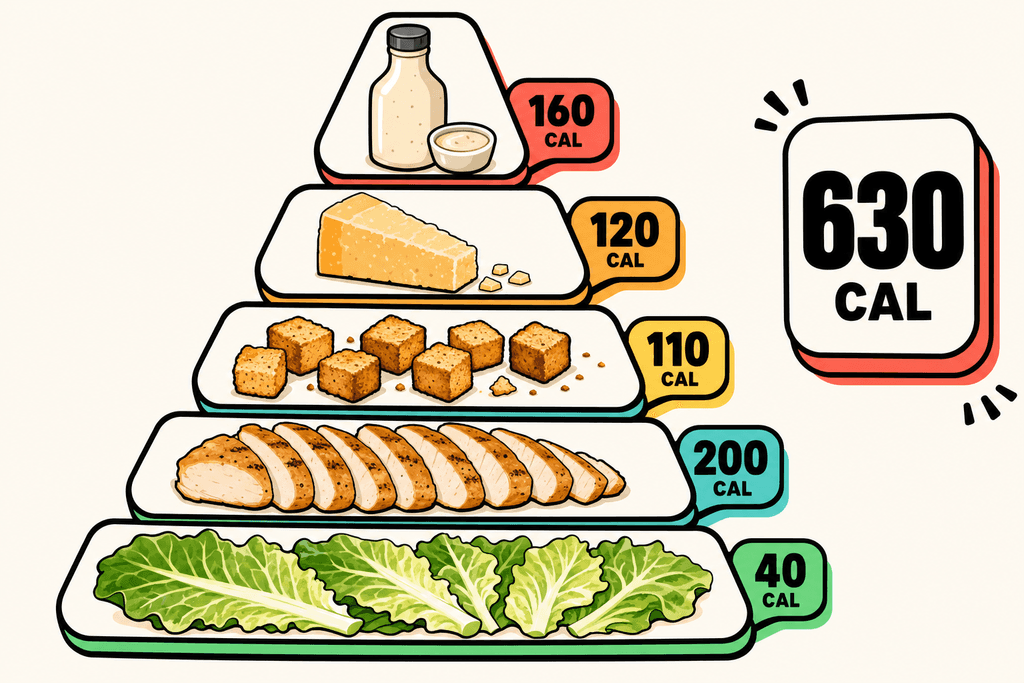
Most people think they're making a healthy choice when they order a Caesar salad for lunch. The word "salad" sounds light and nutritious, right? But here's what actually happens when you dig into that bowl of romaine. The lettuce itself barely registers at 10-20 calories, which is great. Everything else piled on top is where things get interesting.
The Real Calorie Breakdown of Your Caesar Salad
The dressing alone can pack 150-200 calories per 2 tablespoons, and most salads come drenched in 4-6 tablespoons. That's already pushing 600 calories before you even count the toppings.
| Component | Typical Amount | Calories |
|---|---|---|
| Romaine Lettuce | 2 cups | 10-20 |
| Caesar Dressing | 4-6 tablespoons | 400-600 |
| Parmesan Cheese | 1/4 cup | 100-150 |
| Croutons | 1/2 cup | 100-200 |
| Grilled Chicken | 4-6 oz | 200-300 |
| Total | 810-1,270 |
The Parmesan cheese adds another 100-150 calories, and those crunchy croutons contribute 100-200 calories depending on how generous the kitchen feels. Add grilled chicken for protein and you're looking at 200-300 more calories. Restaurant portions are typically 2-3 times larger than what you'd make at home, which means all these numbers get multiplied.
Hidden Calorie Bombs in Restaurant Caesar Salads
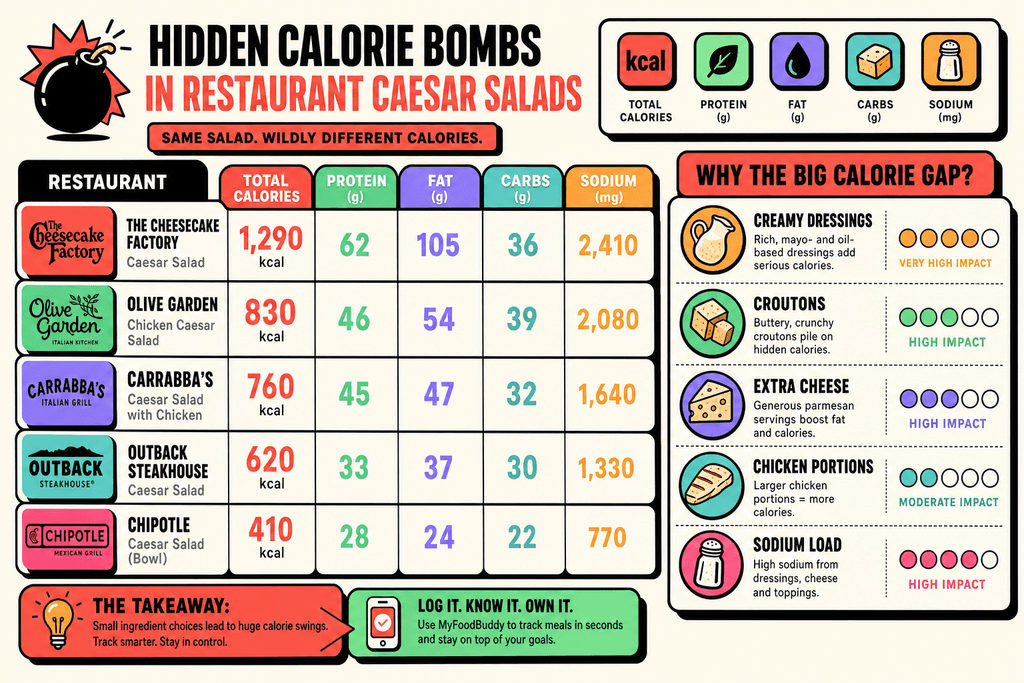
Chain restaurants have turned the humble Caesar salad into a calorie powerhouse. The range is wild, from 600 calories on the low end to over 1,200 calories for some versions. A Panera full-size Caesar with chicken clocks in around 650 calories, which seems reasonable until you realize that's without any modifications. The Cheesecake Factory's version hits closer to 1,100 calories, and Chili's Grilled Chicken Caesar can reach 1,010 calories depending on location.
Hidden Calorie Bombs in Restaurant Caesar Salads
Restaurants use way more dressing and cheese than necessary because it tastes better. They're not thinking about your calorie goals when they're trying to make food you'll want to order again.
- Side Caesar salads typically contain 300-500 calories
- Entree Caesar salads range from 600-1,200 calories
- Adding bacon increases totals by 80-120 calories
- Avocado adds another 100-150 calories
- Crispy chicken instead of grilled adds 150-250 calories
- Sodium content often exceeds 1,500mg (65% of daily limit)
The difference between a side Caesar and an entree Caesar isn't just the protein. You're getting double or triple the dressing, more cheese, and a mountain of croutons. Those add-ons like bacon and avocado sound healthy, but they push your lunch into dinner-level calories without you realizing it.
Making Smarter Caesar Salad Choices Without Giving Up Flavor
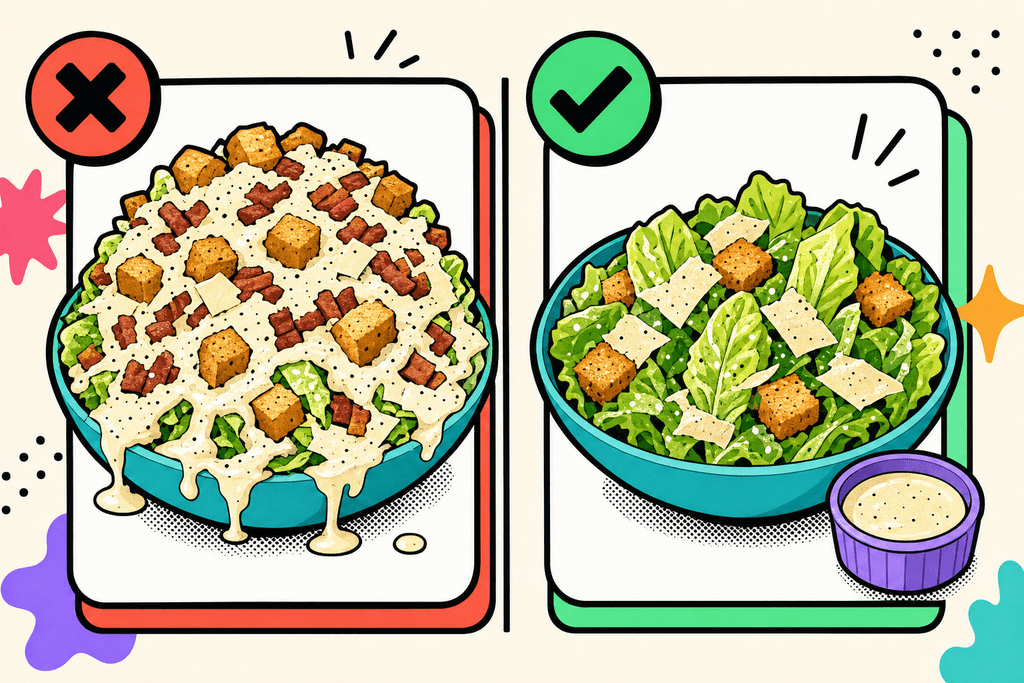
You don't have to give up Caesar salads completely. The trick is knowing where to cut back without making your lunch taste like cardboard. The fork-dip method is simple but effective. Ask for dressing on the side, dip your fork in it, then spear your lettuce. You'll use about half the dressing and barely notice the difference in taste.
Making Smarter Caesar Salad Choices Without Giving Up Flavor
Choosing grilled chicken over crispy saves you 100-200 calories right there. The breading and frying oil add up fast, and grilled chicken actually has more protein anyway.
- Request dressing on the side and use sparingly
- Ask for light cheese or skip it entirely
- Say no to croutons (saves 150+ calories)
- Choose grilled over crispy proteins
- Split an entree salad with a colleague
- Add extra vegetables for volume without calories
Making your own Caesar dressing with a Greek yogurt base cuts calories in half while keeping that creamy texture. Mix Greek yogurt with lemon juice, garlic, anchovy paste, and a little Parmesan. You get the same flavor profile for about 50 calories per serving instead of 150.
The real challenge is tracking all these modifications when you're eating out. When you customize your order with dressing on the side and no croutons, traditional calorie tracking apps make you hunt through databases and adjust portions manually. With MyFoodBuddy, you can just say "Caesar salad with grilled chicken, dressing on the side, no croutons" and the app figures out the rest using AI. It takes seconds instead of minutes of searching and calculating.
Portion control matters more than most people think. Restaurant Caesar salads are huge because bigger portions feel like better value. But you don't need to finish everything on your plate. Eat until you're satisfied, not stuffed. If you're still tracking your intake the old-fashioned way, you might find it helpful to check out how to fit calorie tracking into your hectic day for strategies that actually stick.
Understanding salad caesar calories helps you make better choices without feeling deprived. Whether you're managing a 1500 calorie daily diet or just trying to avoid accidentally eating 1,200 calories at lunch, knowing what's in your food matters. The same awareness applies to other seemingly healthy options, like the lowest calorie fast food meals that might surprise you with their actual nutritional content.
Why Tracking Salad Calories Matters More Than You Think
Research shows that people consistently underestimate the calories in restaurant salads by 250 to 500 calories per meal. That's not just a small rounding error. When you're trying to maintain a 500-calorie daily deficit to lose one pound per week, a single miscalculated caesar salad can wipe out your entire day's progress. The problem gets worse when you consider that most people eat out multiple times per week, turning what should be healthy choices into hidden obstacles.
The Weekly Impact: Underestimating just one restaurant salad per day by 300 calories creates a 2,100-calorie weekly surplus. That's enough to prevent weight loss entirely or even cause gradual weight gain over time.
The psychology behind this is simple but powerful. When we label food as "healthy," our brains give us permission to stop paying attention to portions. A caesar salad sounds virtuous compared to a burger, so we don't question the creamy dressing or the generous portion of parmesan cheese.
The Cumulative Effect on Your Goals
Here's what happens when salad caesar calories go untracked over time:
- Week one: You're 2,100 calories over your target without realizing it
- Month one: That's 9,000 extra calories, or 2.5 pounds of potential weight gain
- Three months: You've consumed 27,000 unaccounted calories while wondering why the scale won't budge
- Six months: The frustration builds as your "healthy eating" doesn't match your results
The solution isn't to avoid salads or spend ten minutes manually entering every ingredient. MyFoodBuddy lets you simply say "caesar salad with grilled chicken from Panera" and the AI handles the nutritional breakdown instantly. No searching through databases or guessing at portion sizes.
Knowing Versus Guessing
There's a massive psychological difference between tracking and guessing. When you know the exact numbers, you can make informed decisions about the rest of your day. Maybe you skip the croutons next time, or you balance it with a lighter dinner. But when you're guessing, you're essentially flying blind while expecting to reach a specific destination.
Taking Control of Your Lunch Calories
Caesar salads aren't the enemy here. The real problem is not knowing what you're actually eating when you order one at a restaurant. A basic caesar salad calories count might start around 300, but most restaurant versions clock in between 600 and 1,200 calories before you even realize it. The dressing alone can pack 300 calories, and those innocent-looking croutons add another 100 to 150. When you understand where the calories hide, you can make smarter choices without giving up foods you enjoy.
Small tweaks make a huge difference. Asking for dressing on the side saves you 200 calories right away. Skipping the croutons or cutting the cheese in half drops another 100 to 150. These simple modifications can turn a 900-calorie lunch into a 400-calorie one, and you'll probably still feel just as satisfied.
The tricky part is keeping track of everything, especially when you're customizing your order. Most tracking apps make you search through endless databases and guess at portion sizes, which takes forever and usually isn't accurate anyway. MyFoodBuddy lets you just say what you ate, like "caesar salad with grilled chicken, light dressing, no croutons," and it figures out the calories for you in seconds using AI and USDA data.
Whether you're trying to maintain a 1500 calorie daily diet or just want to be more aware of what you're eating, knowing your caesar salad calories is half the battle. The other half is having a system that makes tracking easy enough to actually stick with. Once you see the patterns in your eating habits, making better choices becomes almost automatic.
Common Questions About Caesar Salad Calories
Caesar salads seem simple enough, but people run into the same questions when trying to track them accurately. The dressing throws everyone off, and restaurant portions can be wildly different from what you'd make at home. Here are the answers to what people actually want to know about tracking salad caesar calories without losing their minds.
How many calories are in a typical Caesar salad?
A basic Caesar salad with romaine, dressing, croutons, and parmesan runs about 300-400 calories for a side portion. Restaurant entree versions with grilled chicken can hit 600-900 calories, and that's before you add extras like bacon or extra dressing on the side. The dressing alone accounts for roughly half those calories in most cases.
Is Caesar salad healthy for weight loss?
Caesar salad can work for weight loss if you control the portions and know what you're eating. The problem is that most restaurant versions pack more calories than a burger because of heavy dressing and add-ons. A homemade version with light dressing and grilled protein actually makes a solid meal that keeps you full without blowing your calorie budget.
What's the lowest calorie Caesar salad at restaurants?
Panera's Caesar salad without chicken comes in around 330 calories, while Chick-fil-A's Market Salad with a lighter dressing option sits at about 330-360 calories. Your best bet is always asking for dressing on the side and using half of what they give you. Most chains will have nutrition info available if you ask, though the actual portions can vary quite a bit from location to location.
How can I track a customized Caesar salad easily?
Instead of searching through databases and adding each ingredient separately like you'd have to do with traditional apps, you can just describe what you ate in plain language. MyFoodBuddy lets you say something like "Caesar salad with grilled chicken, light dressing, no croutons" and calculates everything automatically. It saves you from the annoying process of measuring tablespoons of dressing or guessing portion sizes.
Does homemade Caesar salad have fewer calories?
Homemade Caesar salads typically have 200-300 fewer calories than restaurant versions because you control the dressing amount and ingredient quality. Restaurants use way more dressing than necessary and often add extra cheese and croutons to make the salad look fuller. Making it yourself means you can use two tablespoons of dressing instead of the quarter cup that restaurants dump on.
What's the healthiest dressing alternative for Caesar salad?
Greek yogurt-based Caesar dressing cuts calories by about 60% compared to traditional versions while keeping that creamy texture. You can also try mixing regular Caesar with lemon juice or red wine vinegar to stretch it further without losing flavor. Some people swap to a light vinaigrette entirely, though at that point you're not really eating a Caesar anymore.
Ready to start tracking smarter?
Download MyFoodBuddy and start tracking your calories by just saying what you ate. No more searching databases or guessing portions.
Get started