
When Voice Recognition Beats Manual Food Logging
Advanced voice recognition cuts food logging from minutes to seconds. Learn why speaking your meals beats typing them for calorie tracking success.
Most people abandon calorie tracking apps within their first week, not because they lack motivation, but because logging a single meal can take several frustrating minutes of searching databases and measuring portions. Traditional apps like MyFitnessPal and Cronometer require you to manually hunt through thousands of food entries, create custom meals, and input exact quantities before you even see your calorie count. Advanced voice recognition has flipped this entire process on its head, letting you simply speak what you ate while apps like MyFoodBuddy handle the calculations in seconds.
Table of Contents
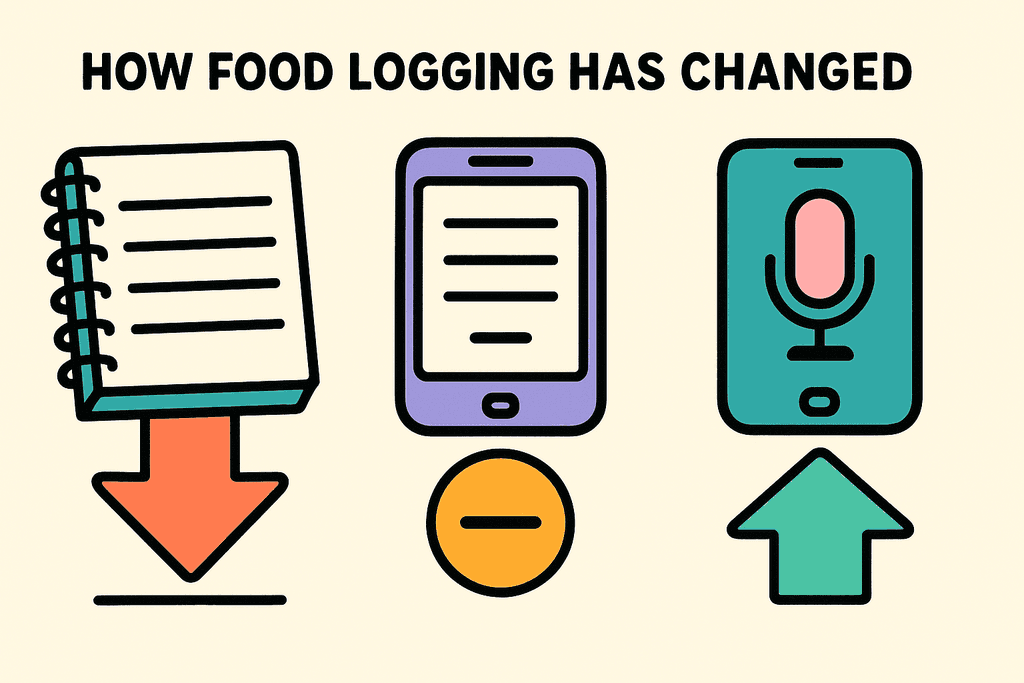
How Food Logging Has Changed
Most people who tried tracking calories in the 1990s used paper notebooks and thick reference books that listed nutrition facts for thousands of foods. You'd flip through pages trying to find "chicken breast, grilled" only to discover there were twelve different entries with wildly different calorie counts. Then came the math part, where you'd calculate portions and add everything up by hand. A single meal could take fifteen minutes to log properly, which is why most people gave up after a week or two.
The Early App Era
When smartphone apps like MyFitnessPal and MyNetDiary appeared in the late 2000s, they seemed like the perfect solution. No more books or calculators needed. But anyone who's used these apps knows the reality is messier than it sounds.
Here's what a typical meal entry looked like with traditional apps:
- Open the app and select which meal you're logging
- Search for the first food item in a database with millions of entries
- Scroll through dozens of similar items with different calorie counts
- Pick one and hope it's accurate, then adjust the portion size
- Repeat this process for every single ingredient or food item
The problem wasn't just the time it took. It was the mental energy required to make dozens of small decisions for every meal. Should you pick the entry that says "chicken breast" or "chicken breast, skinless" or "chicken breast, grilled, no oil"? Each choice felt important because picking the wrong database entry could throw off your entire day's calorie count.
Why People Stopped Tracking
Research shows that most people abandon calorie tracking apps within the first month. The reason isn't lack of motivation. It's friction. When something takes five to ten minutes every time you eat, it becomes a chore instead of a helpful tool.
The biggest complaints about manual food logging include:
- Too many steps required to log a simple meal
- Confusing database entries with conflicting information
- Time-consuming portion size adjustments
- Difficulty logging homemade meals or restaurant food
People wanted to track their nutrition, but the tools available made it feel like a part-time job. Something had to change, and that's where advanced voice recognition technology started making sense as a solution.
The Voice Powered Shift
Voice technology changed how we interact with our phones for everything from sending texts to setting reminders. The same technology that lets you say "call mom" instead of typing could work for food logging too. Instead of tapping through multiple screens, you could just say what you ate and let the app figure out the rest.
Apps like MyFoodBuddy use advanced voice recognition combined with AI to understand natural language. You can say "two eggs, toast with butter, and a coffee with oat milk" and the app calculates everything automatically. What used to take several minutes now takes seconds.
Here's how different tracking methods compare in terms of time spent:
Time Comparison Across Food Logging Methods
Paper Journal Era (1990s)
- Finding food in reference book: 2-3 minutes
- Calculating portions and calories: 2-3 minutes
- Writing everything down: 1-2 minutes
- Total per meal: 5-8 minutes
Traditional App Era (2000s-2010s)
- Searching database for each item: 1-2 minutes
- Selecting correct entry from results: 1-2 minutes
- Adjusting portions for each food: 1-2 minutes
- Total per meal: 3-6 minutes
Voice-Powered Era (2020s)
- Speaking what you ate: 10-15 seconds
- AI processing and calculation: 5-10 seconds
- Reviewing and confirming: 10-15 seconds
- Total per meal: 25-40 seconds
The difference isn't just about saving time. When logging takes less than a minute, it stops feeling like work. You're more likely to actually do it, which means better data and better results. That's the real advantage of voice-powered tracking over the old manual methods.
Why Voice Wins on Speed and Convenience
Most people spend between three to five minutes logging a single meal in traditional calorie tracking apps. That's because you have to search through massive databases, scroll past similar items, adjust serving sizes, and sometimes create custom entries when you can't find exactly what you ate. When you're doing this three to six times a day, that's up to half an hour of your life spent just recording what you put in your mouth.
Voice logging changes everything about this process. With advanced voice recognition, you can log an entire meal in ten to fifteen seconds. Just say what you ate, and the app handles the rest. No searching, no scrolling, no manual calculations.
- Natural language processing understands how real people talk about food
- You can log while driving, cooking, or doing literally anything else
- No need to remember exact database terms or create custom meals
- The system processes your voice input and calculates nutrition automatically
Apps like MyFoodBuddy use this technology to make logging feel effortless. You just speak naturally, like you're telling a friend what you had for lunch. The app figures out the portions, cooking methods, and nutritional breakdown without you lifting a finger.
The time savings add up fast. If you save four minutes per meal and log three meals a day, that's twelve minutes daily or over seventy hours per year. That's almost two full work weeks you get back just by talking instead of typing and searching.
Accuracy Without the Guesswork
The biggest concern people have about voice logging is whether it's actually accurate. After all, if you're trying to hit specific nutrition goals, you need reliable data. The good news is that modern voice recognition systems are built on the same databases as manual entry apps, they just access that information differently. Most systems pull from USDA nutrition databases, which means the underlying data is consistent whether you type it or speak it.
What makes voice logging surprisingly accurate is how well it understands context. When you say "grilled chicken breast," the AI knows that's different from "fried chicken breast." It catches details about cooking methods and portion sizes that you might forget to specify when manually searching through a database.
The technology behind this is pretty smart. Natural language processing can interpret phrases like "a handful of almonds" or "a medium apple" without you needing to convert everything to grams or ounces. It understands the way humans naturally describe food portions.
- AI systems use USDA databases for consistent nutrition information
- Context awareness catches details manual searches might miss
- No need to memorize specific commands or formats
- The system learns from corrections to improve over time
Here's something interesting about how this works in practice. If you say "two eggs, toast with butter, and a coffee with oat milk," the system breaks that down into individual components. It knows eggs are typically large eggs unless you specify otherwise. It understands that toast usually means one slice per serving. It recognizes that coffee with oat milk needs to account for both items separately.
The accuracy improves the more you use it too. When you make corrections or adjustments, the AI learns your preferences and patterns. If you always have your coffee with two tablespoons of oat milk, it starts to remember that. This is something you can see in action with voice-powered tracking apps that adapt to your eating habits.
The Psychology of Sticking With It
The hardest part of calorie tracking isn't learning how to do it. It's doing it every single day for weeks and months. Most people quit tracking within the first two weeks, not because they don't understand the concept, but because the daily friction becomes too much. When something takes five minutes and feels like a chore, you start finding excuses to skip it. First you skip logging snacks, then maybe lunch, and before you know it, you've stopped tracking altogether.
Voice logging removes most of that friction. When logging takes fifteen seconds instead of five minutes, the mental barrier disappears. You don't have to decide whether you have time to log your meal because it happens almost instantly. This lower time investment means less decision fatigue about whether to track what you just ate.
- Immediate logging prevents forgetting meals later in the day
- Reduced frustration leads to consistent tracking habits
- Voice logging feels more like a conversation than a chore
- Consistency is the biggest predictor of tracking success
There's also something about speaking your meals out loud that makes the process feel different. It's more like having a quick chat than filling out a form. This subtle psychological shift matters more than you might think. When tracking feels conversational rather than administrative, you're more likely to actually do it.
The data backs this up too. Users who switch to voice-powered tracking tend to log meals more consistently than those using traditional manual entry. The easier something is, the more likely you are to build it into a lasting habit. And with nutrition tracking, consistency beats perfection every single time.
If you're struggling to maintain tracking habits with traditional apps, exploring voice-powered alternatives might be exactly what you need. The technology handles the tedious parts so you can focus on actually reaching your goals instead of spending your time searching through food databases.
The bottom line is simple. Voice recognition doesn't just make calorie tracking faster. It makes it sustainable. And sustainable habits are the only ones that actually lead to long-term results. Whether you're trying to lose weight, gain muscle, or just understand your eating patterns better, the method you can stick with is always going to beat the method that's theoretically perfect but too annoying to maintain. For more tips on building consistent habits, check out our guide on staying consistent with tracking.
When Voice Recognition Makes the Biggest Difference
Most people who quit calorie tracking apps do so within the first two weeks, and the reason is almost always the same: it takes too long. The difference between voice and manual logging isn't just about speed, it's about whether tracking fits into your actual life or becomes another chore you avoid. Advanced voice recognition changes the equation completely because it removes the friction that makes people give up in the first place.
The gap between voice and manual input becomes most obvious in specific situations. When you're juggling a toddler on one hip and trying to remember what you ate for lunch, typing out "grilled chicken salad with olive oil dressing" isn't happening. When you're walking between meetings with a protein bar in hand, pulling out your phone to search through databases feels impossible.
Who Benefits Most from Voice Logging
Certain types of people see dramatically better results with voice-based tracking. The pattern shows up clearly in user behavior and retention rates.
- Busy professionals who eat meals during commutes or between meetings can't spare five minutes to manually log each ingredient
- Parents managing family meals while handling kids need hands-free options that work in chaotic moments
- People who previously abandoned apps like MyFitnessPal or Cronometer due to time constraints find voice removes their main barrier
- Anyone eating restaurant meals or complex home-cooked dishes with multiple ingredients benefits from natural speech instead of searching databases
- Shift workers or travelers with irregular schedules maintain consistency more easily when logging takes seconds
Situations Where Voice Wins
The advantage of advanced voice recognition becomes clear when you compare specific scenarios. Some situations make manual logging nearly impossible while voice works perfectly.
Voice Excels
- Logging meals while driving or commuting to work
- Tracking food while cooking or cleaning up the kitchen
- Recording complex meals with 5+ ingredients without searching databases
- Maintaining daily streaks when you're tired or busy
- Quick logging at restaurants before forgetting what you ordered
Manual Input Works Better
- Precise macro adjustments for competitive athletes or bodybuilders
- Quiet environments like libraries or meetings where speaking isn't appropriate
- Reviewing and editing past entries in detail
- Creating custom recipes you'll use repeatedly with exact measurements
The real insight here is that voice doesn't replace manual input entirely. It removes the barrier for daily consistency. MyFoodBuddy uses advanced voice recognition to handle the 80% of logging that used to take 80% of your time, so you can actually stick with tracking long enough to see results.
Making Food Tracking Actually Work
The biggest reason people quit tracking their food isn't because they don't care about their health. It's because the process takes too long and feels like homework. When you have to search through databases, measure portions, and tap through multiple screens just to log a simple breakfast, it's no wonder most people give up within a few weeks. Advanced voice recognition changes this completely by removing the friction that makes traditional calorie counting such a pain.
Voice logging turns a five-minute task into a ten-second one. You just say what you ate, and the app handles everything else. This speed difference might not sound like much, but it's the difference between tracking consistently and giving up after a few days.
The technology has gotten good enough that you can trust it for serious nutrition goals. Apps like MyFoodBuddy use advanced voice recognition combined with AI and USDA data to give you accurate nutritional information without the manual work. You're not sacrificing accuracy for convenience anymore.
Here's what matters most about voice-powered tracking:
- You'll actually stick with it because it's fast
- You can log meals anywhere without pulling out your phone to type
- The barrier between thinking about tracking and actually doing it basically disappears
- Your consistency improves, which means better results
If you've tried tracking before and quit because it took too much time, voice technology makes the whole process simpler. The question isn't whether voice recognition works better than manual logging. It's whether you're ready to try an approach that might actually fit into your real life.
Common Questions About Voice Food Logging
Voice logging is still pretty new for most people who track calories, so it makes sense that you'd have questions. The idea of just talking to your phone instead of typing everything out sounds great, but how does it actually work in real life? Here are the most common questions people ask about using advanced voice recognition for food tracking, along with honest answers that'll help you figure out if it's right for you.
How accurate is voice recognition for food logging?
Modern voice recognition technology has gotten really good at understanding natural speech, even with background noise or accents. MyFoodBuddy uses advanced voice recognition combined with AI that's trained on USDA nutritional data, so it can accurately identify foods and calculate their nutritional values. The system gets smarter over time as it learns your eating patterns and common foods.
Can voice logging handle complex meals with multiple ingredients?
Yes, you can describe entire meals in one go. Just say something like "grilled chicken breast with brown rice, steamed broccoli, and olive oil" and the app breaks it down into individual components. You don't need to log each ingredient separately like you would with traditional apps such as MyFitnessPal or Cronometer. The AI processes everything you say and calculates the total nutritional values automatically.
What happens if the app doesn't understand what I said?
The app shows you what it heard and the nutritional breakdown it calculated, so you can review and edit if needed. If something looks off, you can either re-record your entry or make quick adjustments manually. Most of the time though, the advanced voice recognition gets it right on the first try.
Do I need to speak in a specific format or can I talk naturally?
You can talk completely naturally, just like you're telling a friend what you ate. There's no special format or keywords required. Say "I had two eggs and toast with butter" or "ate a chicken salad for lunch" and it works either way. The whole point is to make logging feel effortless, not like you're programming a computer.
Is voice logging secure and private?
Your voice data is processed securely and isn't stored permanently or shared with third parties. The app only uses your voice input to convert it into text and nutritional data, then the audio itself is discarded. Your food logs and health information stay private to your account.
Can I use voice logging in public places?
While you can technically use voice logging anywhere, some people feel more comfortable using it in private settings. The good news is that MyFoodBuddy also supports text input, so you can type your meals when you're in a quiet office or restaurant. You're not locked into one method, which gives you flexibility based on where you are and what feels comfortable at the moment.
Ready to start tracking smarter?
Download MyFoodBuddy and start tracking your calories by just saying what you ate. No more searching databases or guessing portions.
Get started