
MFP Macro Calculator vs Simpler Macro Tracking
Discover why MFP macro calculator users are switching to simpler tracking methods. Compare features, ease of use, and find your perfect fit.
Most people abandon macro tracking within the first two weeks, not because they lack motivation, but because logging every meal feels like a part-time job. The mfp macro calculator has been the standard tool for years, helping millions set their protein, carbs, and fat targets, but actually hitting those numbers requires endless searching, weighing, and manual entry that eats up 3-5 minutes per meal. Apps like MyFoodBuddy are changing this by letting you simply say what you ate and getting your macros calculated in under 10 seconds, which might explain why so many people are finally sticking with their nutrition goals.
Table of Contents
What Makes Macro Tracking So Complicated
Most people who try tracking their macros quit within the first two weeks. The reason isn't that they don't understand what protein, carbs, and fats are. It's because the actual process of logging food has become a massive time sink that feels more like a part-time job than a helpful habit. Traditional apps like MyFitnessPal require you to search through databases with thousands of entries, weigh every ingredient, and manually verify that the nutrition info is even correct.
The Traditional Tracking Process
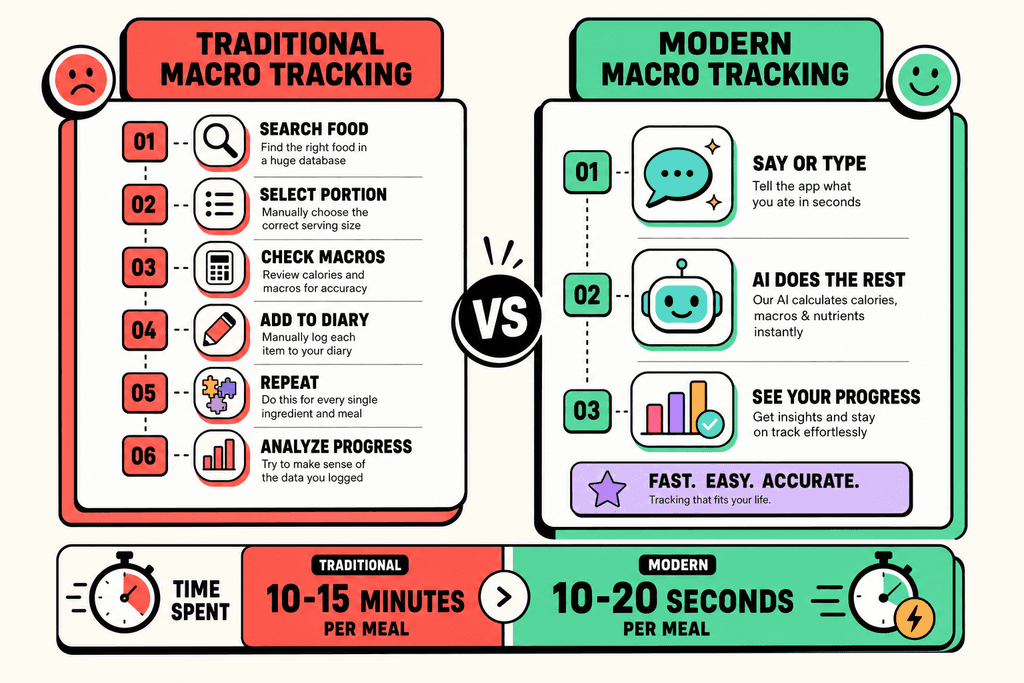
Here's what most people deal with when they use an mfp macro calculator or similar tools. You make a simple chicken salad for lunch, and suddenly you're stuck in your kitchen for 15 minutes trying to log it properly.
The steps look something like this:
- Search the food database for each ingredient separately
- Scroll through dozens of similar entries to find the right one
- Weigh each ingredient on a food scale
- Convert measurements if the app uses different units
- Double-check that the macro numbers seem accurate
And that's just for one meal. The average person spends 15-20 minutes per day doing this across breakfast, lunch, dinner, and snacks. That adds up to over 90 hours per year just typing food into an app.
Why the Old Way Creates Burnout
The problem gets worse when you're eating out or having meals you didn't prepare yourself. You're stuck guessing portion sizes and searching for generic restaurant entries that might not match what you actually ate.
| Tracking Method | Time Per Meal | Daily Time Spent | Steps Required |
|---|---|---|---|
| Traditional Apps (MFP) | 5-7 minutes | 15-20 minutes | 8-12 steps |
| Voice-Based Apps | 30-60 seconds | 2-4 minutes | 1-2 steps |
Apps like MyFoodBuddy have changed this by letting you just say what you ate. Instead of searching databases and weighing food, you speak naturally and the AI handles the calculations using USDA data.
Understanding Macros Shouldn't Be the Hard Part
Most people actually get the basics pretty quickly. Protein helps build muscle, carbs give you energy, and fats support hormone function. The math isn't complicated either when you use an mfp macro calculator to set your targets based on your goals.
The real barrier is the daily grind of logging. When tracking takes longer than actually eating your meal, something's broken. People don't fail at macro tracking because they lack discipline. They fail because the tools make it unnecessarily complicated.
- Searching food databases wastes time you could spend cooking or exercising
- Weighing every ingredient makes eating feel like a science experiment
- Manual entry errors throw off your entire day's calculations
- The friction of logging makes you skip meals or quit entirely
The good news is that tracking doesn't have to be this way anymore. Modern approaches focus on speed and simplicity rather than making you do all the work yourself.
How the MFP Macro Calculator Works
Most people who track macros have used MyFitnessPal at some point. The app has been around for years and built up a massive database with millions of food entries. When you want to log a meal, you open the app, search for each food item, scroll through dozens of similar entries, pick the right one, adjust the portion size, and then verify the nutritional info looks correct. The mfp macro calculator itself is pretty solid for setting up your daily targets based on your goals, but getting your actual food into the system is where things get tedious.
The process sounds simple enough until you're doing it three to five times a day, every single day. You end up spending several minutes per meal just to log what you ate. And that's assuming the food you're looking for is even in the database with accurate information.
Common Frustrations with Traditional Tracking
- Searching through duplicate entries where the same food appears dozens of times with different nutritional values
- Verifying accuracy because user-submitted entries often contain errors
- Dealing with ads and paywalls that interrupt your logging flow
- Creating custom meals requires saving each ingredient separately first
- Time investment that adds up to 10-15 minutes daily just for food logging
The interface hasn't changed much over the years either. What worked in 2015 feels clunky now when you're used to apps that understand natural language and automate repetitive tasks. Many users stick with it simply because they've already invested so much time building their meal history and don't want to start over.
Pros and Cons of MFP Macro Calculator
| Advantages | Disadvantages |
|---|---|
| Huge food database | Time-consuming searches |
| Detailed macro tracking | Accuracy verification needed |
| Free basic version | Ads interrupt workflow |
| Established user base | Outdated interface |
| Barcode scanning | Manual portion adjustments |
The reality is that consistency matters more than perfection when tracking macros. But if the tool you're using makes it hard to stay consistent, you're fighting an uphill battle from day one.
The Rise of Voice-Based Macro Tracking
Technology has changed how we interact with our phones in almost every area except food tracking. You can ask your phone to set reminders, send texts, play music, and answer questions, but until recently, logging your meals still meant typing and tapping through multiple screens. Voice-based tracking changes that entire equation by letting you speak naturally about what you ate instead of hunting through databases.
The difference is pretty dramatic when you actually use it. Instead of opening an app, tapping the search bar, typing "scrambled eggs," scrolling through results, selecting one, changing the portion from 1 egg to 2 eggs, and then repeating that process for toast and coffee, you just say what you ate. The AI handles the rest, pulling nutritional data from sources like the USDA database and calculating your macros automatically.
How Voice Logging Actually Works
- You describe your meal in plain language, like you're telling a friend
- AI technology extracts the food items and estimated portions
- The system matches items to verified nutritional databases
- Your macros get calculated and logged in seconds
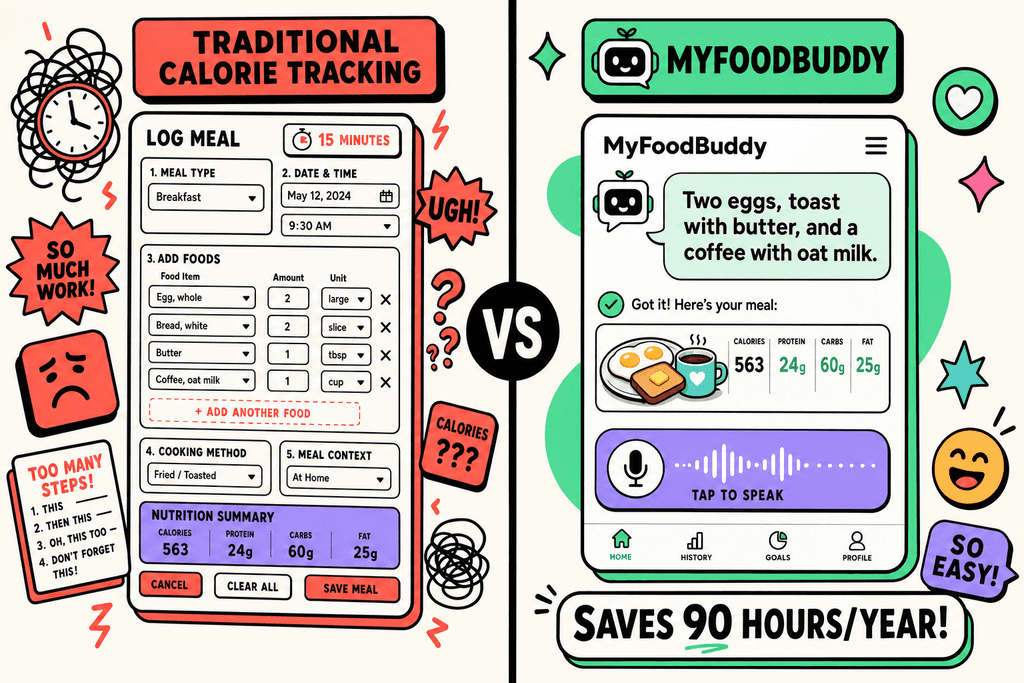
Apps like MyFoodBuddy have built this technology specifically for food tracking. You can say "two eggs, toast with butter, and a coffee with oat milk" and the app understands what you mean. It doesn't need you to specify that the eggs are large or that the toast is whole wheat unless you want to be that specific. The system makes reasonable assumptions based on common portions and lets you adjust if needed.
The time savings add up fast. What used to take three to five minutes per meal now takes maybe 30 seconds. Over a week, that's the difference between spending an hour on food logging versus spending less than 10 minutes. That's not a small difference when you're trying to build a habit that sticks for months or years.
The technology isn't just about speed though. When tracking becomes this easy, you're more likely to actually do it consistently. You can log meals right after eating them instead of trying to remember everything at the end of the day. You can track that handful of almonds or that extra coffee without it feeling like a chore worth skipping.
Which Tracking Method Fits Your Lifestyle
Choosing between traditional macro calculators and simpler voice-based tracking isn't about which one is objectively better. It's about which one you'll actually use consistently based on your specific situation. Some people genuinely enjoy the detailed control of manual tracking, while others need something that fits into their busy schedule without adding mental overhead. The right choice depends on a few key factors that are worth thinking through before you commit to a tracking method.
Your tracking goals matter a lot here. If you're working with a nutritionist who needs detailed micronutrient data or you're managing a specific health condition that requires precise tracking, you might need the granular control of traditional apps. But if your main goal is staying within your macro targets for weight management, simpler tools often work just as well without the extra complexity.
Questions to Ask Yourself
- How much time can you realistically spend logging food each day?
- Do you need to track specific micronutrients or just macros and calories?
- Are you comfortable with AI making reasonable assumptions about portions?
- Have you quit tracking apps before because they felt too tedious?
- Do you eat similar meals regularly or have a highly varied diet?
- Would you rather spend 30 seconds or 5 minutes logging each meal?
Your tech comfort level plays a role too. Some people prefer the familiar interface of apps they've used for years, even if those apps require more manual work. Others are ready to try newer approaches that use AI and voice input. Neither preference is wrong, but being honest about what you're comfortable with helps you pick a tool you won't abandon after two weeks.
The consistency factor is probably the most important consideration. The best tracking method is the one you'll still be using three months from now. If manual logging feels manageable for a few days but becomes a burden over time, you'll eventually stop doing it. A simpler system you use every day beats a detailed system you use occasionally. That's just how habit formation works.
Think about your daily routine too. If you're logging meals on the go, between meetings, or while managing kids, voice input makes a lot more sense than typing. If you mostly track at home with time to spare, manual entry might not bother you. The context of when and where you're logging matters as much as the tool itself.
For most people trying to stay consistent with tracking calories, the simpler approach wins out. That's why apps focused on ease of use, like MyFoodBuddy, have gained traction among people who struggled with traditional trackers. The barrier to entry is lower, and the daily friction is minimal. You can learn more about automating your calorie tracking to save time and see how modern tools compare to older methods.
The tracking landscape has options now that didn't exist a few years ago. Whether you stick with the mfp macro calculator approach or try something built around voice and AI, the key is matching the tool to your actual lifestyle instead of the lifestyle you wish you had. If you're curious about alternatives to MyFitnessPal for AI meal tracking, it's worth exploring what's available before defaulting to what everyone else uses.
Why People Are Switching Away from MFP
The average person spends 15 minutes per day logging food in traditional calorie tracking apps, which adds up to nearly 90 hours per year. That's more time than most people spend meal prepping, yet the mfp macro calculator and similar tools still require this level of commitment. Users are starting to realize that the problem isn't their willpower or dedication, it's the tools themselves creating unnecessary barriers. When logging a simple breakfast takes five minutes of searching, selecting, and adjusting portion sizes, it's no wonder people give up after a few weeks.
The Real Cost of Complicated Tracking
The friction built into traditional macro calculators goes beyond just time. Every extra tap, search, and manual adjustment creates another opportunity to quit. Research on habit formation shows that the easier a behavior is to complete, the more likely it becomes automatic.
- Manual entry requires remembering exact portion sizes and ingredients
- Database searches often return dozens of similar items with varying nutritional values
- Creating custom meals involves multiple screens and data entry fields
- Editing mistakes means navigating back through the same complicated process
What Users Actually Say
The testimonials tell a consistent story. People aren't leaving the mfp macro calculator because they don't care about tracking anymore. They're leaving because the tool makes consistency feel impossible.
"I've been a user of MyFitnessPal for a few years now and lately it's been annoying. It's been really easy to use this app on the go where I don't have to create a bunch of meals and spend time searching it." – Mirro R.
"I used to use a different calorie tracking app, but switching to foodbuddy has been great and much more convenient. I like just being able to say what I've eaten and it calculates all the calories for me." – JakeVdub608
The Retention Gap
Apps that reduce logging time from minutes to seconds see dramatically higher retention rates. When tracking becomes as simple as sending a text message, it stops feeling like a chore. MyFoodBuddy takes this approach by letting users speak or type naturally instead of hunting through databases.
- Voice logging eliminates the need to type or search entirely
- Natural language processing understands "two eggs and toast" without manual selection
- Favorite meals can be re-logged instantly without rebuilding them
The best macro tracker isn't the one with the most features or the largest food database. It's the one you'll actually open every single day without dreading the process.
Finding Your Perfect Macro Tracking Match
The mfp macro calculator has helped millions of people track their nutrition over the years, and there's a reason it became so popular. If you're someone who likes having complete control over every detail and doesn't mind spending a few extra minutes on each meal entry, traditional macro tracking tools can work really well. The problem is that most people don't fall into that category, which is why staying consistent with tracking becomes such a challenge after the first few weeks.
Voice-based tracking removes the biggest barrier that stops people from logging their meals. Instead of searching through databases and adjusting portion sizes, you just say what you ate and move on with your day. MyFoodBuddy uses this approach to make tracking feel less like homework and more like a quick check-in.
The right choice really depends on what fits your lifestyle. Some people genuinely enjoy the detailed process of manual tracking, while others need something that takes seconds instead of minutes. Different tracking methods work for different personalities, and there's no shame in picking the easier option if it means you'll actually stick with it.
The best tracker is the one you'll use tomorrow, next week, and next month. If you've tried traditional apps before and found yourself giving up after a while, it might be worth exploring more user-friendly options that prioritize speed and simplicity. Your goals matter more than the tool you use to reach them.
Common Questions About Macro Tracking
Switching from a traditional macro calculator to a simpler tracking method brings up a lot of questions. Most people wonder if they'll lose accuracy, whether their past data matters, and if the easier approach actually works. Here are the answers to the most common concerns people have when considering a switch from the mfp macro calculator to something more straightforward.
How accurate is voice-based macro tracking compared to manual entry?
Voice-based tracking uses the same USDA nutritional database that manual entry apps rely on, so the accuracy is essentially identical. The difference is just how you input the information. When you say "two eggs and toast with butter," the AI interprets this the same way you would manually search for each item. MyFoodBuddy processes your natural language and matches it to verified nutritional data, giving you the same numbers without the tedious searching and clicking.
Can I switch from MFP to a simpler app without losing my data?
While you can't directly transfer your historical logs from one app to another, most people find they don't actually need their old data once they start fresh. Your body doesn't care about past logs, it responds to what you're doing right now. If you've been tracking for a while, you already know your patterns and portion sizes. Starting with a cleaner, easier system often feels like a relief rather than a loss.
Do I need to track macros every single day to see results?
Consistency matters more than perfection. Tracking five or six days a week is usually enough to keep you aware and on track toward your goals. The key is making tracking so easy that you actually do it regularly. When logging takes 30 seconds instead of five minutes, you're far more likely to stick with it on busy days. That's where simpler apps have a real advantage over complex systems like the mfp macro calculator.
What's the minimum information needed to track macros effectively?
You really just need to know what you ate and roughly how much. You don't need to weigh everything on a food scale or measure to the exact gram. Describing your meal in plain language like "chicken breast, rice, and broccoli" gives you enough data to track your macros. The AI fills in reasonable portion sizes based on common servings, and you can adjust if needed. This approach gets you 90% of the accuracy with 10% of the effort.
How do free trials work for macro tracking apps?
Most macro tracking apps, including MyFoodBuddy, offer a 7-day free trial so you can test the features before committing. You get full access to everything during the trial period, including voice logging, the AI nutrition coach, and all analytics features. If the app doesn't fit your needs, you can cancel before the trial ends. It's a no-risk way to see if a simpler tracking method actually saves you time and helps you stay consistent with your nutrition goals.
Ready to start tracking smarter?
Download MyFoodBuddy and start tracking your calories by just saying what you ate. No more searching databases or guessing portions.
Get started