
Eat at Parties Without Gaining Weight Using Apps
Learn how to enjoy parties without weight gain. Track calories effortlessly with voice-powered apps and smart strategies for guilt-free eating.
You show up to a party hungry and ready to have fun, but three hours later you've mindlessly eaten enough appetizers and desserts to equal an entire day's worth of calories. Most people don't realize they're consuming between 1,500 to 3,000 extra calories at a single social event, which is why traditional calorie tracking apps like MyFitnessPal fail at parties—they're too slow and awkward to use when you're trying to socialize. Apps like MyFoodBuddy change this completely by letting you track what you eat at parties without gaining weight, using simple voice commands that take seconds instead of minutes.
Table of Contents
Why Parties Are Calorie Traps
Most people eat about 1,500 extra calories at a single party without even realizing it. That's almost an entire day's worth of food packed into a few hours of socializing. The problem isn't that you lack willpower or don't care about your health. It's that parties are designed in a way that makes it nearly impossible to track what you're eating.
Your Brain Stops Paying Attention
When you're chatting with friends or meeting new people, your brain focuses on the conversation, not the food going into your mouth. This is called mindless eating, and it happens to everyone at parties. You grab a handful of chips here, a cookie there, and before you know it, you've eaten way more than you planned.
Social pressure makes things worse. When everyone around you is eating and drinking, it feels weird to be the only one not joining in. You don't want to seem rude or antisocial, so you keep saying yes to food offers even when you're not hungry.
- Conversations distract you from noticing how much you eat
- Standing and moving around makes it harder to track portions
- Multiple food stations mean you lose count of trips
- Alcohol lowers your ability to make good food choices
Party Foods Pack Hidden Calories
Party foods are specifically chosen because they taste good, which usually means they're loaded with fat, sugar, and salt. A single appetizer that fits in your palm can have 200-300 calories. The worst part is that these foods don't fill you up, so you keep eating without feeling satisfied.
Unlike meals at home where you can see the whole portion, party foods come in unclear amounts. How big was that slice of pizza? How much dip did you use? Was that a small or large meatball? These questions are impossible to answer accurately when you're eating and socializing at the same time.
| Party Food | Serving Size | Calories |
|---|---|---|
| Cheese and crackers | 5 crackers with cheese | 250 |
| Chicken wings | 4 wings | 350 |
| Spinach artichoke dip | 1/4 cup with chips | 300 |
| Mini quiches | 3 pieces | 280 |
| Cocktail meatballs | 5 meatballs | 320 |
| Chocolate cake | 1 slice | 400 |
| Mixed nuts | 1/4 cup | 200 |
| Pigs in a blanket | 4 pieces | 280 |
Traditional Tracking Doesn't Work at Parties
Apps like MyFitnessPal require you to search through databases, measure portions, and input each ingredient separately. Imagine trying to do that while holding a drink and talking to your boss. It's not going to happen. The average person spends 3-5 minutes logging a single meal in traditional calorie tracking apps, which is way too long when you're in the middle of a social event.
You'd need to step away from conversations, pull out your phone, and spend several minutes searching for each food item. By the time you finish logging one plate, you've already grabbed another. This is exactly why most people give up on tracking at parties, even when they're serious about their health goals. Tools like MyFoodBuddy solve this by letting you quickly log everything with voice commands in seconds, so you can stay present at the party while keeping track of what you eat.
- Searching food databases takes too long during social events
- Estimating portions is nearly impossible without measuring tools
- Multiple small bites are easy to forget and hard to log
- Stopping to type on your phone looks antisocial
Track Everything Without Looking Antisocial
Most people who try to track calories at parties end up standing in a corner, typing frantically into their phones while everyone else is having fun. The problem with traditional calorie tracking apps is that they require you to search through databases, measure portions, and tap through multiple screens just to log a handful of chips. But there's a better way that doesn't make you look like you're texting during a conversation.
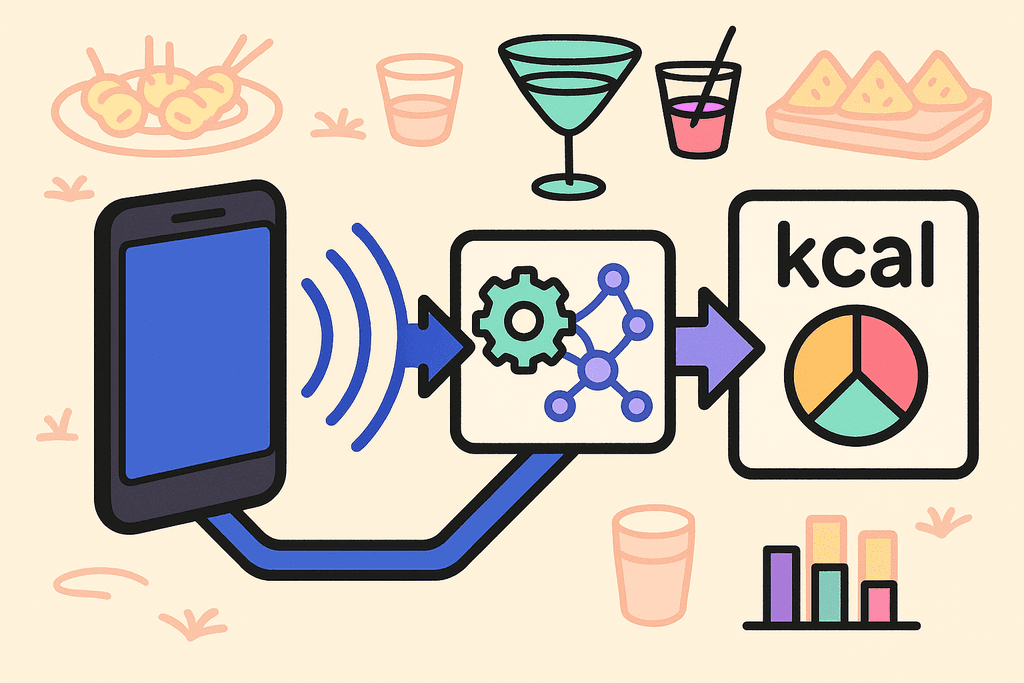
Voice logging changes everything because you can track your food while still being part of the party. Instead of pulling out your phone and staring at it for two minutes, you can discreetly speak into your device for just a few seconds. Apps like MyFoodBuddy let you say something like "three chicken wings, some potato salad, and a beer" and the AI figures out the rest using USDA data.
How to Log Food in Under 10 Seconds
- Step outside or find a quiet corner for just a moment
- Open your tracking app and hit the voice button
- Describe what you ate in natural language
- Let the AI calculate the nutritional values automatically
- Return to the party without missing the conversation
The beauty of natural language processing is that you don't need to be precise. You can say "a handful of pretzels" or "a couple slices of pizza" and the app will make reasonable estimates. This works even in noisy environments because most voice recognition technology has gotten pretty good at filtering out background noise.
Track Everything Without Looking Antisocial
You can also batch log multiple items at once, which saves even more time. Instead of logging each appetizer separately as you eat it, wait until you've had a few things and then list them all in one voice command. MyFoodBuddy processes everything in seconds, so you're not stuck waiting for the app to catch up with your eating.
Smart Strategies for Staying Within Your Goals
The real challenge at parties isn't tracking the food, it's making choices that won't wreck your progress. You could eat nothing and feel miserable, or you could eat everything and regret it the next day. Neither option sounds great, but there's a middle ground that actually works if you plan ahead.
Setting a calorie budget before you arrive gives you a framework to work within. If you know you have 800 calories to spend at the party, you can make informed decisions about what's worth it and what isn't. This is where having an app with real-time tracking becomes useful because you can check your remaining budget throughout the night.
The Plate Method for Parties
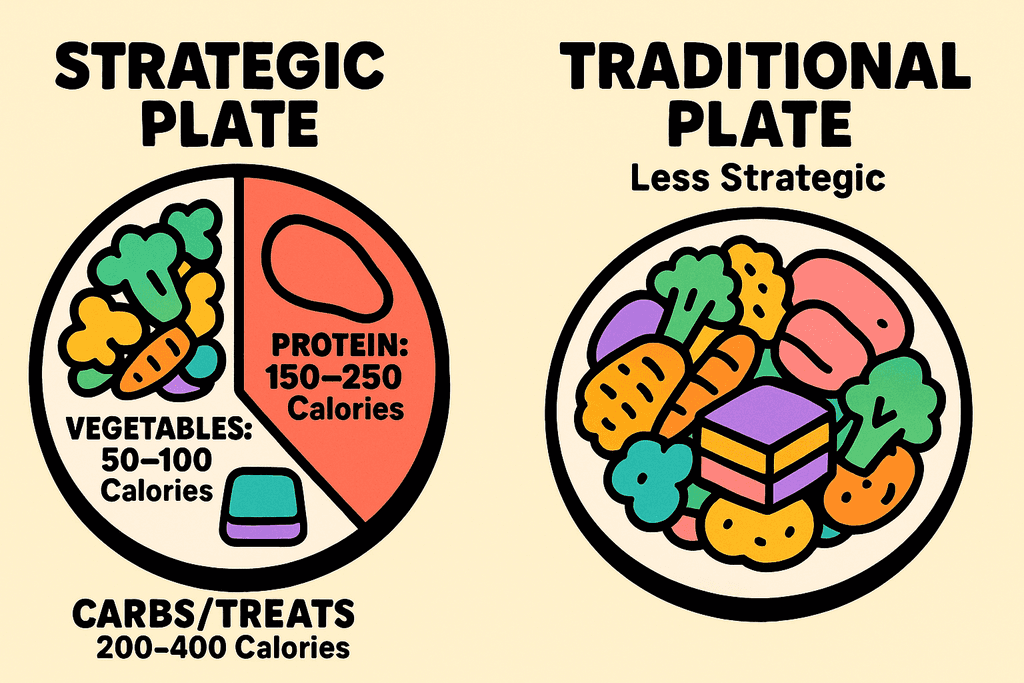
When you're at a buffet or party spread, building your plate strategically makes a huge difference. Fill half your plate with vegetables or salad, a quarter with protein like chicken or fish, and the remaining quarter with whatever carbs or treats you really want. This approach lets you enjoy party food without going overboard on calories.
Smart Strategies for Staying Within Your Goals
| Food Type | Portion | Typical Calories |
| Vegetables | Half plate | 50-100 |
| Protein | Quarter plate | 150-250 |
| Carbs/Treats | Quarter plate | 200-400 |
Drinks are where most people accidentally consume hundreds of extra calories. A single margarita can have 300 calories, and if you have three throughout the night, that's 900 calories just from drinks. Alternating alcoholic drinks with water or choosing lower-calorie options like vodka soda instead of sugary cocktails can save you significant calories.
The data from your tracking app becomes really valuable when you're deciding what to eat next. If you've already used 600 of your 800 calorie budget, you know you need to be selective about dessert. Some apps like MyFoodBuddy even have an AI coach that can give you personalized suggestions based on what you've already eaten and your remaining goals for the day.
Making It Work in Real Party Situations
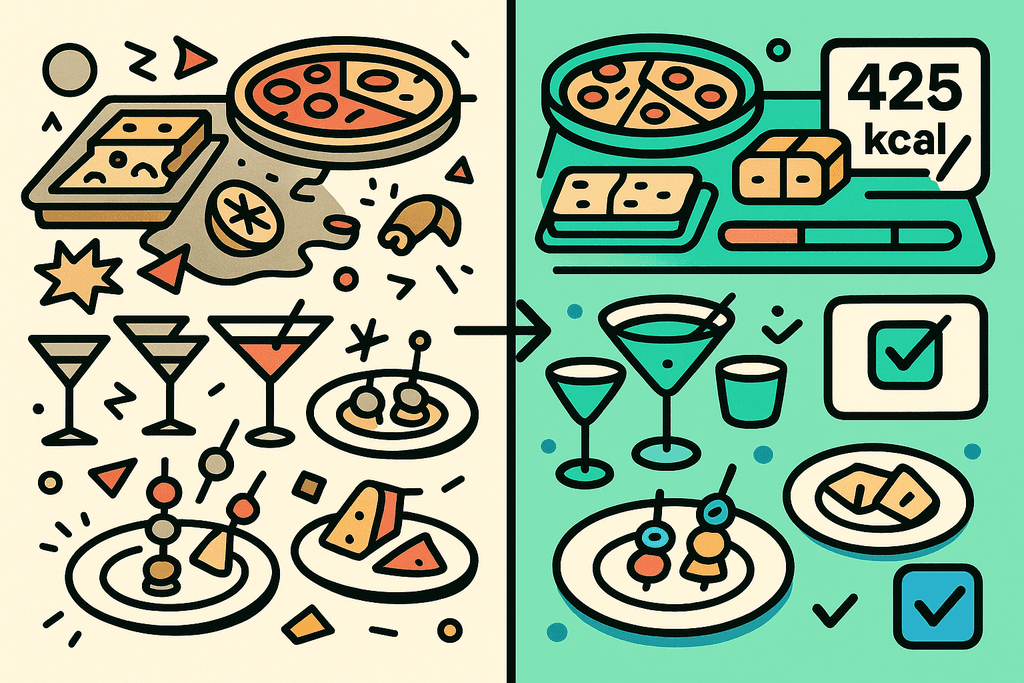
Different types of parties require different tracking strategies. A cocktail party where you're grazing on small bites all night is completely different from a sit-down dinner with multiple courses. The key is adapting your approach to match the situation, not trying to force the same method everywhere.
Buffets are actually easier to track than you might think because you can see all your options at once. Before you start filling your plate, walk the entire buffet to see what's available. This prevents you from loading up on mediocre options and then discovering something better at the end. Visual portion estimation gets easier with practice, but most apps can help when you're unsure.
Handling Cocktail Party Grazing
- Keep a mental tally of small bites as you go
- Log every 30-60 minutes instead of after each bite
- Use your app's favorites feature for common party foods
- Estimate conservatively when portion sizes are unclear
Sit-down dinners require a different approach because the food comes in courses and you can't always see what's coming next. The trick is to log each course as it arrives, which gives you a running total and helps you decide how much to eat of each dish. If the appetizer was heavy, you might eat less of the main course to stay within your goals.
Making It Work in Real Party Situations
AI-powered apps like MyFoodBuddy are particularly helpful when you're dealing with homemade or restaurant food where exact portions are impossible to know. The AI uses its database of similar foods to make educated guesses about nutritional content. It's not perfect, but it's way better than not tracking at all or spending 10 minutes trying to find the exact match in a database.
Creating meal templates for foods you encounter regularly at parties saves tons of time. If you go to a friend's house every month and they always serve similar appetizers, save those items as a favorite meal. Next time, you can log the entire spread with one tap instead of entering each item individually. This feature alone can reduce logging time from minutes to seconds, which means you're more likely to actually do it.
The goal isn't to track with perfect accuracy or to stress about every calorie. It's about staying aware of what you're eating so you can make choices that align with your goals while still enjoying social events. Apps that make tracking quick and easy, like the voice-powered features in MyFoodBuddy, remove most of the friction that causes people to give up on tracking altogether. When logging takes 10 seconds instead of 5 minutes, it becomes something you can actually maintain long-term, even at parties.
Why Voice Tracking Changes the Game
The average person spends 3-5 minutes logging a single meal in traditional calorie tracking apps like MyFitnessPal or Cronometer. That might not sound like much until you're standing at a party buffet table trying to remember if you grabbed the chicken skewers or the beef ones, how many crackers you ate, and whether that dip was hummus or ranch. When you multiply those minutes across breakfast, lunch, dinner, and snacks at social events, you're looking at 15-20 minutes of daily data entry. Most people quit tracking within two weeks because the friction is just too high.
Voice-powered apps like MyFoodBuddy flip this equation completely. You can log an entire party plate in under 10 seconds by simply saying what you ate. The difference isn't just about saving time, though that matters a lot when you're trying to eat at parties without gaining weight.
The Friction Factor
Behavioral psychology research shows that every extra step in a process reduces completion rates by about 20%. Traditional tracking apps require you to search databases, scroll through options, adjust serving sizes, and confirm entries. Voice tracking removes all of that.
- Traditional apps: Search, select, measure, adjust portions, confirm (5+ steps)
- Voice apps: Speak what you ate (1 step)
- Time saved per meal: 2-4 minutes on average
- Adherence improvement: Users report 3x better consistency with voice tracking
The compound effect shows up fast. If you attend two social events per week and actually log your food instead of giving up, that's 104 tracked occasions per year versus maybe 10-15 with traditional methods.
Accuracy Without the Effort
Here's where it gets interesting. Many people assume manual database searching is more accurate than AI extraction, but user data tells a different story. When you're manually searching through thousands of entries for "chicken wing" in apps like Calory or FoodNoms, you're often picking the wrong variation or guessing at portion sizes anyway.
| Method | Time Per Meal | Accuracy Rate | Party Scenario Usability |
|---|---|---|---|
| Traditional Manual Entry | 3-5 minutes | 65-75% | Low |
| Voice AI (USDA-backed) | 10-15 seconds | 80-85% | High |
| Photo Recognition | 1-2 minutes | 60-70% | Medium |
AI systems trained on USDA data actually perform better because they're pulling from standardized nutritional databases rather than user-submitted entries that might be wildly inconsistent. MyFoodBuddy uses this approach to give you reliable numbers without the guesswork.
What Real Users Say
People who've switched from traditional apps consistently mention the same thing. It's not just about speed, it's about actually sticking with tracking when life gets messy. One user who moved from MyFitnessPal noted that the app became "annoying" after years of use, specifically calling out how easy voice tracking is "on the go where I don't have to create a bunch of meals and spend time searching."
- Former long-term users of traditional apps report frustration with multi-step processes
- Voice tracking users mention convenience as the top reason they maintain consistency
- Social situations specifically benefit from discreet, quick logging
The pattern is clear. When tracking takes seconds instead of minutes, people actually do it. And when you can eat at parties without gaining weight, it's because you're tracking consistently enough to make informed decisions, not because you're avoiding social events altogether.
Your Next Party Can Be Different
Parties don't have to derail your health goals anymore. The strategies we covered, from eating before you go to choosing protein-rich options and staying mindful of liquid calories, all work together to help you enjoy social events without the guilt. The key is planning ahead and being smart about your choices, not avoiding fun altogether.
Technology makes this whole process way easier than it used to be. Instead of trying to remember everything you ate at a party and logging it hours later, you can just speak into your phone. MyFoodBuddy lets you say something like "two sliders, handful of chips, and a glass of wine" right after you eat, and it handles all the calculations for you. No searching through databases or guessing portion sizes while you're supposed to be having fun.
The truth is, most people who try to track calories at parties give up because traditional apps take too long. Voice tracking changes that because it takes about five seconds. You can step away for a moment, log your food, and get back to the conversation without anyone noticing.
Here's what makes the biggest difference:
- Plan your eating strategy before the party starts
- Use voice tracking to log food quickly without disrupting your social time
- Focus on protein and vegetables when possible
- Stay aware of how many drinks you're having
Your health goals and your social life don't have to compete with each other. With the right approach and tools that actually fit into real life, you can eat at parties without gaining weight. If you're tired of apps that feel like homework, voice-powered calorie tracking for special occasions might be exactly what you need. The next time you get invited somewhere, you'll know exactly what to do.
Common Questions About Party Tracking
Tracking food at parties brings up a lot of questions, especially if you're new to using apps for this purpose. Most people worry about accuracy, forgetting to log things in the moment, or dealing with foods they've never seen before. The good news is that modern calorie tracking apps have gotten pretty smart about handling these exact situations. Here are the most common questions people ask about using apps to eat at parties without gaining weight.
How accurate is voice logging for party foods?
Voice logging is surprisingly accurate for most party foods because apps like MyFoodBuddy use AI and USDA data to recognize common dishes and ingredients. You can say something like "two slices of pepperoni pizza and a handful of chips" and the app will calculate reasonable estimates. The accuracy depends more on how well you describe portion sizes than the voice recognition itself.
What if I forget to log something during the party?
You can always log foods after the party ends, even hours later. Most apps let you backdate entries or adjust meal times so your tracking stays organized. It's actually better to enjoy the party and log everything in one go afterward than to stress about real-time tracking and miss out on conversations.
Can I track alcohol with voice commands?
Yes, you can track alcohol just like any other food or drink using voice commands. Just say "one glass of red wine" or "two light beers" and the app will log the calories and nutrients. Alcohol tracking is important because drinks can add hundreds of calories that people often forget about when they're focused on food.
How do I estimate portions at a buffet?
Use your hand as a measuring tool at buffets. A palm-sized portion equals about 3-4 ounces of protein, a fist is roughly one cup, and a thumb is about one tablespoon. You don't need to be perfect with estimates because consistent tracking matters more than perfect accuracy. Apps are designed to work with reasonable guesses, not laboratory precision.
Is it okay to go over my calories at a party?
Going over your calories at one party won't ruin your progress as long as you get back on track the next day. Weight management is about your average intake over weeks and months, not single days. Many people actually plan for parties by eating lighter earlier in the day or the day before.
What if the app doesn't recognize a specific party food?
If the app doesn't recognize something, describe it using basic ingredients instead. For a mystery casserole, you might say "chicken, cheese, pasta, and cream sauce" and the app will calculate based on those components. MyFoodBuddy's AI is pretty good at understanding these kinds of descriptions and giving you a reasonable estimate without needing the exact recipe.
Ready to start tracking smarter?
Download MyFoodBuddy and start tracking your calories by just saying what you ate. No more searching databases or guessing portions.
Get started